Reducing Context Switching for Engineers Handling Support Escalations
Tool fragmentation, not ticket volume, drains engineering productivity.
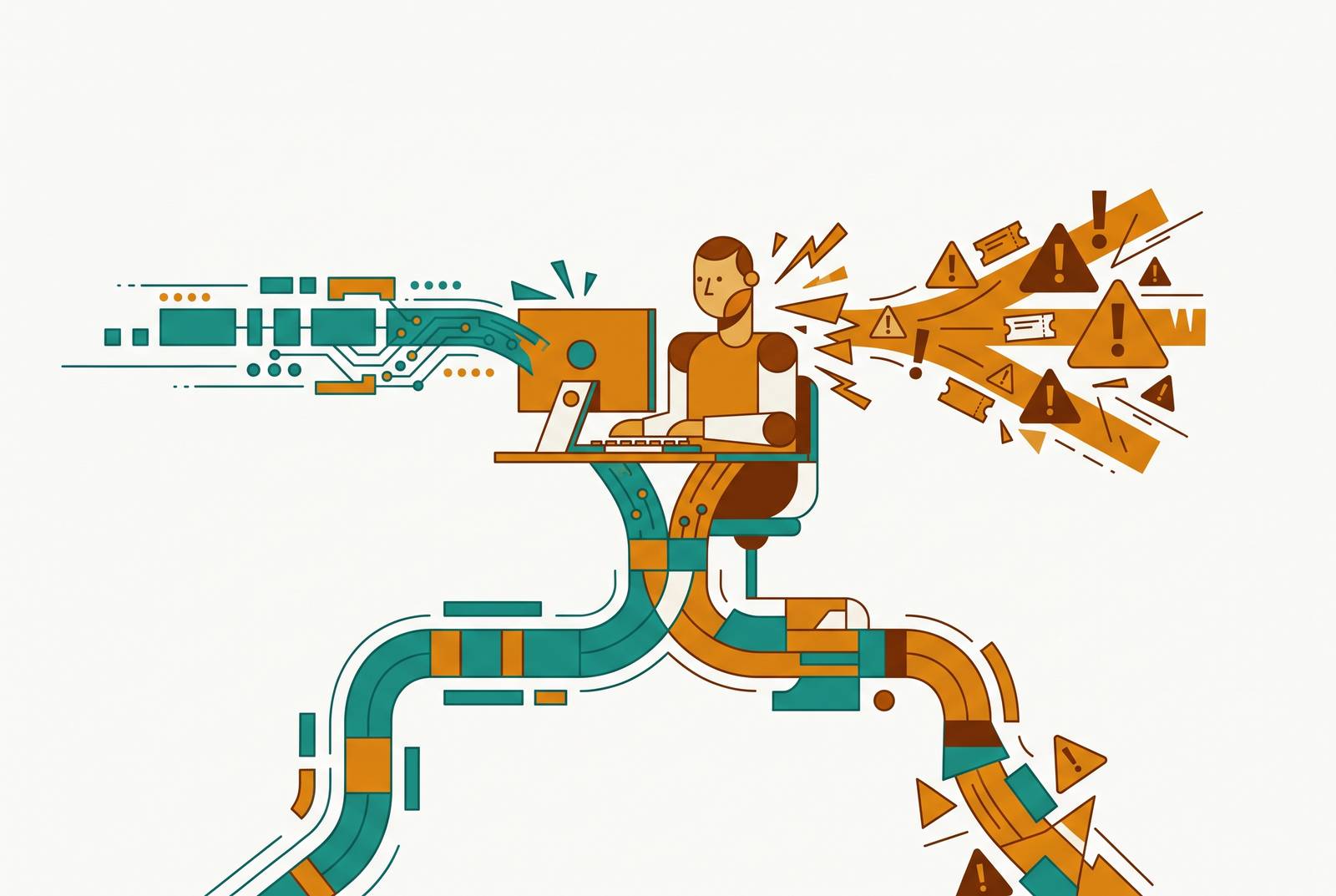
Picture an engineer forty-five minutes into a tricky race condition, finally circling the cause, when a Slack notification lands: a customer says the API is throwing 500s. They open the helpdesk tool. Read the ticket. Switch to GitHub to check logs. Switch back to the helpdesk to reply. Then they try to return to the race condition, and the thing that made that bug solvable, the exact state of variables, the logic they'd half-built in their head, is gone. They're starting over.
That reset is the actual cost of a support escalation, and it has almost nothing to do with how long the ticket took to answer. Engineering work depends on holding a fragile structure in working memory: system state, variable values, the chain of logic connecting one function to another. Email can survive an interruption because nothing fragile was being held. A debugging session cannot. The moment attention moves to a different tool, that structure collapses, and rebuilding it costs far more than the few minutes the ticket itself required.
Timing makes it worse. A meeting sits on a calendar, so an engineer can route around it, finish a thought before it starts, resume after it ends. A ticket gives no such warning. It lands whenever a customer happens to hit a bug, often in the middle of the exact kind of deep focus that takes thirty minutes to build and seconds to destroy. And the damage doesn't just add up across a day, it stacks. An engineer handling several tickets isn't paying a flat tax per interruption. Each reset makes the next one harder to recover from, because the baseline of focus they're returning to keeps getting shallower.
What makes escalations structurally expensive: tool fragmentation
The instinct is to treat this as a volume problem: too many tickets, not enough hours. That's the wrong frame. The expense comes from how many separate tools an engineer has to cross to close out a single ticket, not from how many tickets arrive in a day.
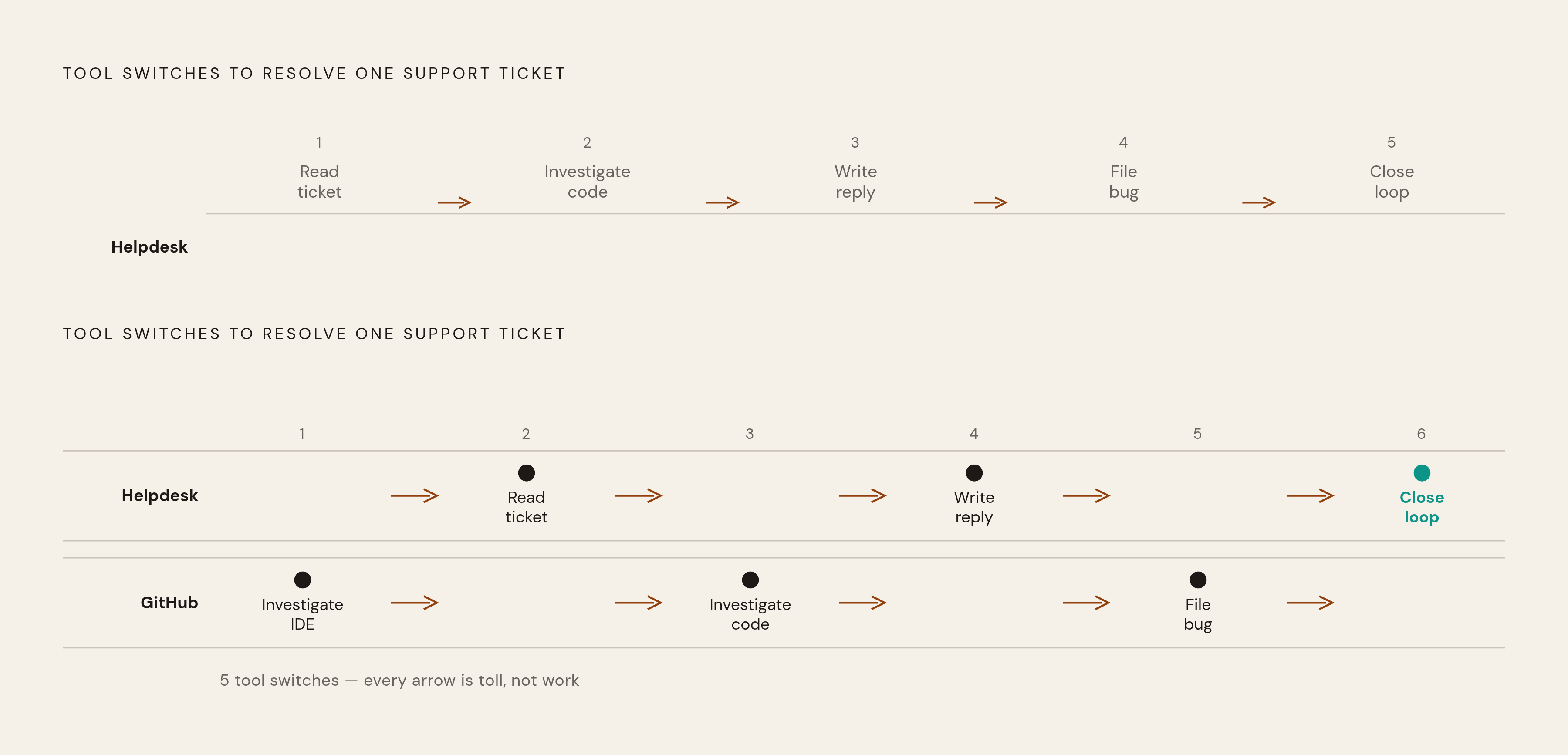
Trace an actual ticket that results in a bug fix. An engineer starts in their IDE or GitHub. A ticket arrives, so they open the helpdesk interface to read it. They switch back to GitHub to investigate the code. They return to the helpdesk to write a reply. If the issue is a real bug, they go to GitHub Issues to file it. Then back to the helpdesk once more to close the loop. That's five or six border crossings, and each one carries its own interface, its own workflow logic, its own moment of reorientation before any actual thinking can resume. None of that is the investigation itself. It's the toll charged just to get there.
There's a second layer to this, less obvious but just as corrosive: when the state of a piece of work isn't visible anywhere outside the tool it lives in, people start asking about it. A manager wants a status update. A support rep wants to know if the fix is close. Those check-ins feel small individually, but they're interruptions too, and they're generated by the same root issue, which is that work state is locked inside a tool nobody but the engineer can see into.
One obvious response is to batch the interruptions, letting tickets pile up and handling them twice a day. That helps with frequency. It does nothing about the six-tool relay each batched ticket still runs through once the engineer sits down to handle it. Fewer trips through the maze doesn't make the maze shorter.
How most teams respond to escalation pressure
Three responses show up almost everywhere escalations are a problem: batching tickets into scheduled blocks, rotating a designated support-duty engineer, and using AI to summarize and triage incoming tickets. Each one genuinely helps. None of them fixes the underlying structure that produces the problem.
Batching takes the context-switch count from "every time a ticket arrives" down to something like twice a day, and that's a real reduction in how often an engineer gets yanked out of focused work. But once that batch session starts, every individual ticket in it still forces the same IDE-to-helpdesk-to-GitHub-and-back sequence. The cost per switch hasn't moved. Only the number of switch events across the day has.
Rotation concentrates the damage onto one person. One engineer takes the support queue for a day or a week, absorbing every interruption so the rest of the team can stay heads-down. That protects everyone else's flow state, which matters, but the total switching tax the organization pays doesn't shrink. It just gets loaded entirely onto one person's shoulders, who now lives inside the relay race full time.
AI-driven triage, which summarizes, categorizes, and prioritizes tickets automatically, shortens the front end of the process. Instead of opening and reading a full ticket thread to understand what's being asked, an engineer scans a summary. That's a legitimate improvement, and it saves real time. But it only compresses the part of the relay that happens before the tool-hopping starts. It doesn't remove a single border crossing from the IDE-to-helpdesk-to-GitHub sequence that follows.
What connects all three fixes is that they manage how engineers enter the relay race. None of them redesigns the track itself. Batching changes how often the race starts. Rotation changes who runs it. Triage speeds up the starting gun. The course stays exactly as long and exactly as fragmented as it was before.
Where Most Escalations Originate
So if the fix isn't in managing the inflow better, where does it live? Look closer at what's inside these escalations: a large share of them were never engineering problems.
Think about the questions that actually land on an engineer's desk. What does this customer's account look like right now? Why did this record change last week? Is this subscription still active? None of those require debugging skill. They require a look at the database. They reach an engineer only because no one else has a sanctioned way to take that look.
A support agent needs to check a subscription status or confirm a transaction, and without a safe, permissioned way to see that data, there are exactly two options. Ask an engineer to run a SQL query, or hand the agent direct database credentials. Neither survives contact with reality. The first turns every engineer into an on-call data clerk. The second is a security problem waiting to happen.
Engineers end up functioning as a human query layer, answering questions that need database access rather than an engineer's judgment, because the tooling offers no other route to the answer. The ticket system routes "the API is broken" and "what's this customer's plan tier" upward the same way, unable to tell them apart.
That distinction matters: this category of escalation isn't a symptom of product failure, but a symptom of an access gap. A genuine bug has to be found and fixed. A data-lookup question just needs someone to be let in the door. One of those categories can be engineered away entirely, and it has nothing to do with making engineers faster at handling tickets.
Giving non-engineers a safe, direct path to the data that drives most escalations
Once the access gap is named as the cause, the fix follows directly: stop routing data-lookup questions through engineers. Give support, ops, and sales staff a governed way to reach production data themselves, one that doesn't require SQL and doesn't require an engineer sitting in the loop.
That interface has three jobs to do. It needs to let non-technical staff browse, search, filter, and, where it's appropriate, edit records through a clean, ordinary-looking UI, no query language required. It needs to enforce row-level permissions, so a support agent can see a customer's account details without being able to touch billing rates or anything else sensitive. And it needs to log every action taken, so there's a full audit trail of who looked at what and who changed what.
That third requirement isn't decoration. The permission layer is what makes the whole thing safe to build. It has to come first, not get bolted on afterward. Role-based access control has to separate what a given role can touch from what that job actually requires, and when new tables get added to the schema, they need to inherit the right grants automatically. Otherwise every schema change quietly reopens the access gap the whole system was built to close.
The obvious objection here is that this trades control for convenience, that letting non-engineers near production data is asking for trouble. But the permission architecture is the direct answer to that worry. The real question was never whether non-engineers should touch production data, but under what conditions and with what constraints they do it. A well-designed access layer makes those conditions explicit and checkable after the fact. The governed interface is the one that's actually auditable, not the riskier option.
Containing the context an engineer does need when an escalation is genuinely technical
None of this touches the escalations that should reach an engineer: a genuine bug, an API failure, an anomaly turning up in production data. Those still need to land on an engineer's desk. The question is what happens once they do.
For those tickets, the switching cost comes down to how much context the engineer has to gather before investigation can even start. Go back to the relay race from the first section: IDE to helpdesk to GitHub and back. Most of that overhead goes toward assembling the facts needed to begin solving the problem, not toward solving it.
If support work and engineering work lived in the same environment, that assembly step would shrink dramatically. Instead of loading an entirely different application with its own interface and workflow logic, the engineer would just be looking at a different issue inside a tool they already know. The tool boundary itself is where most of the cognitive reset happens, so collapsing that boundary is where most of the savings sit.
Concretely, that means surfacing support-relevant signals, error rates, record states, recent changes tied to a specific customer ID, inside the environment an engineer already works in. Instead of spending minutes hunting across systems to reconstruct what happened to a given account, the engineer gets it in a glance. That's the highest-leverage moment in the whole investigation, the point where most of the wasted time currently sits. The goal isn't one more dashboard competing for attention, but making the environment an engineer already lives in simply contain the facts, so there's nothing left to go hunting for.
What the structural reorganization looks like end to end
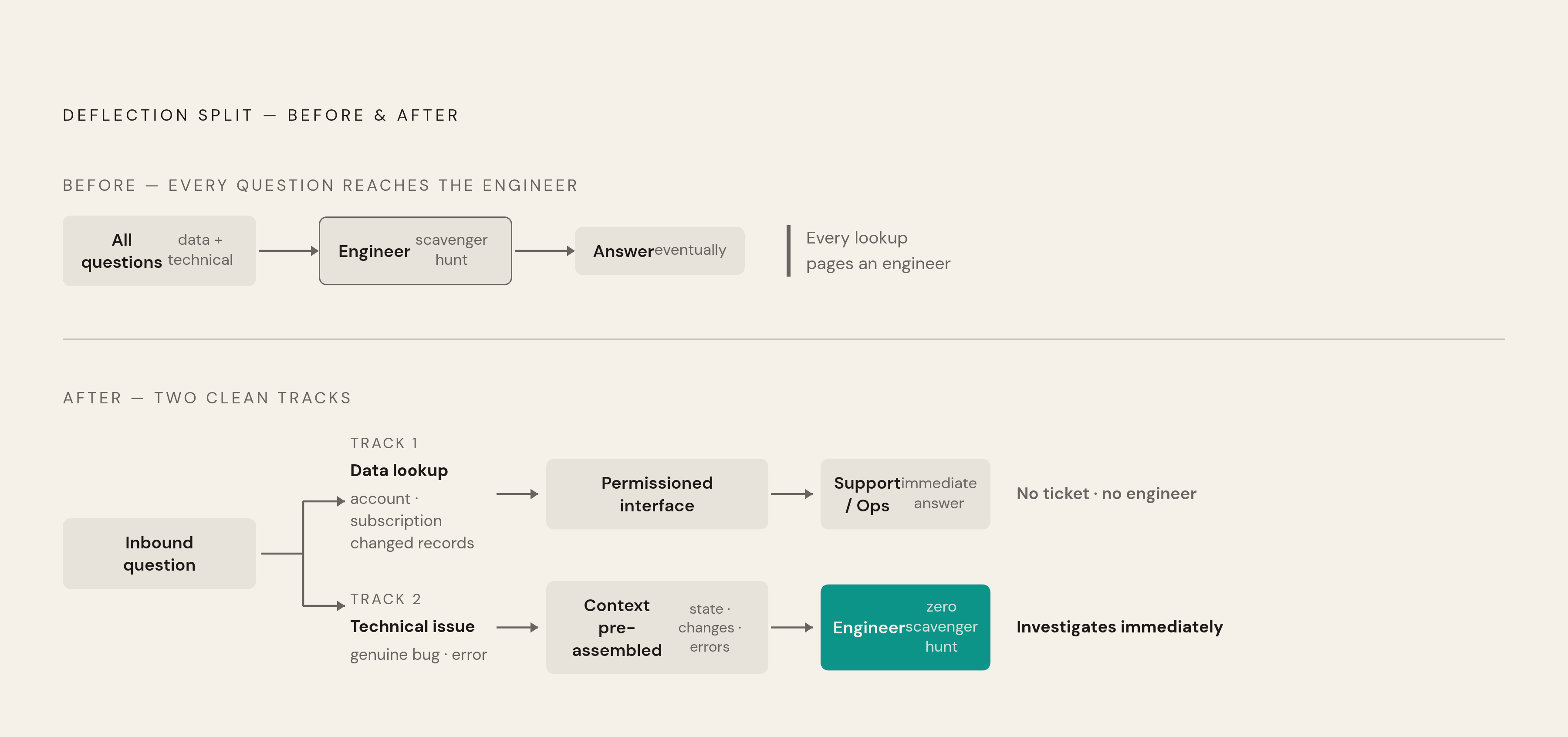
Together, the two fixes split the workflow into two tracks: a self-serve track and a contained-escalation track.
The first track is self-serve. Questions that are really data lookups, account status, subscription state, a record that changed, get handled directly by support and ops staff through the permissioned interface described above. No ticket gets filed. No engineer gets paged. The person asking the question gets the answer immediately, because they were given a door to the data themselves.
The second track is contained escalation. Genuine technical issues still reach an engineer, but by the time they do, the context has already been assembled, account state, recent changes, error details, attached to the ticket rather than left for the engineer to go dig up after the fact. The first tool hop in the old relay disappears, so investigation can begin inside the engineer's own environment.
Each role changes under this split. Support staff resolve account questions and record corrections themselves, with no ticket and no wait, which also means the customer on the other end gets an answer faster. Engineers open an escalation that already has the facts attached, so there's no scavenger hunt before the real work starts. And across the team as a whole, two separate costs drop at the same time: fewer tickets ever reach an engineer in the first place, because the deflectable ones were deflected, and the ones that do reach them cost less, because the context arrived pre-assembled instead of needing to be built from scratch. Fewer support escalations, faster resolution, and a team that stays in flow more of the day: that's the outcome this reorganization is built to produce, and it comes from redesigning where knowledge and data access live, not from asking engineers to interrupt their work more gracefully.
A practical build-vs-buy question follows from this. A custom admin panel and data-access layer built in-house takes weeks of engineering time up front, and it needs ongoing maintenance every time the schema changes. A platform built for this purpose gets to the same place in hours, with much less of that maintenance burden falling on the engineering team going forward. Either way, the time spent is time not spent on internal tooling, which was never the product to begin with.