Eliminating Manual Access Reviews by Codifying Role-Scoped Customer Data Rules in Your Internal Tool
Enforce access rules at the database layer to eliminate manual permission reviews.
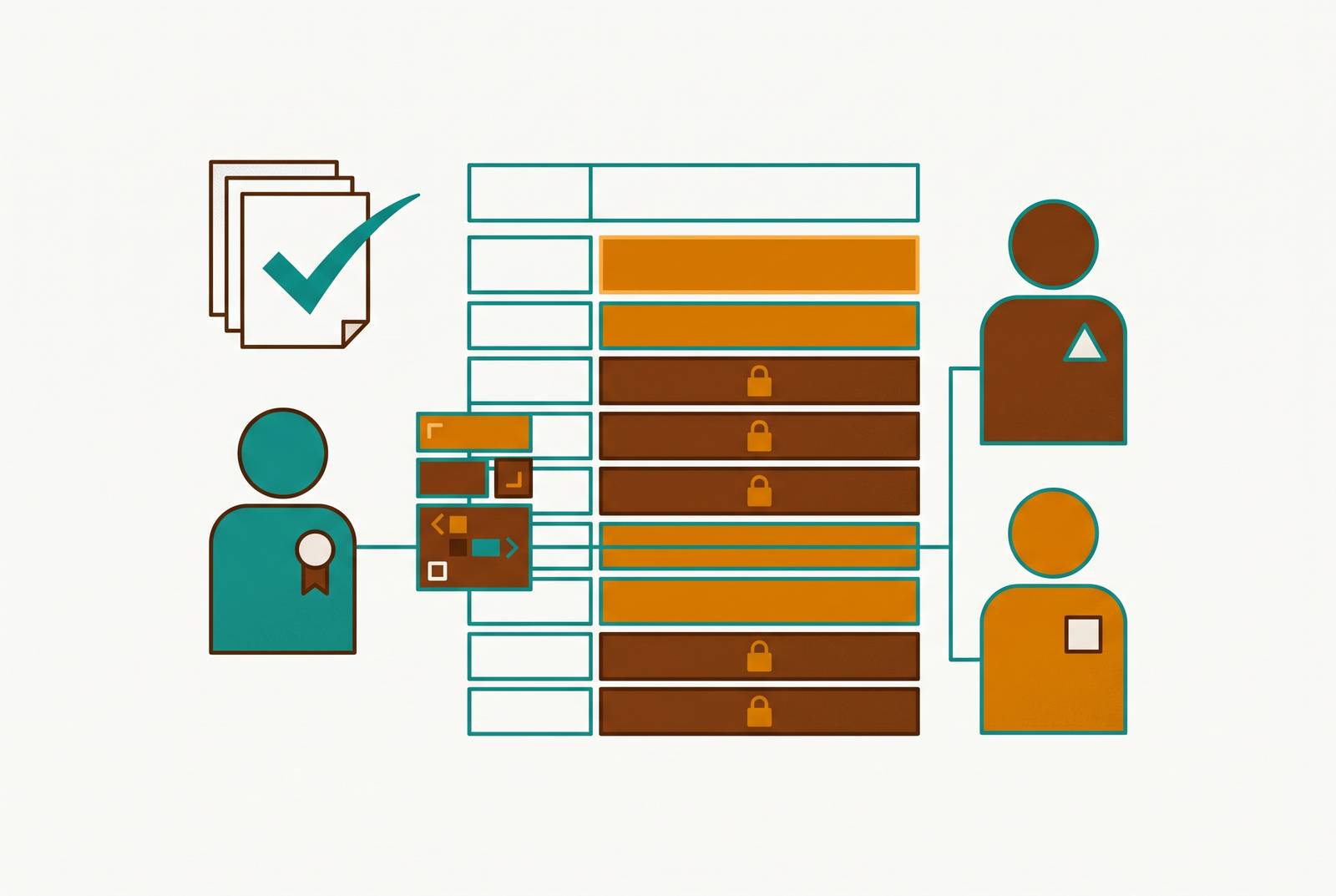
Least-privilege access control for internal database tools means enforcing role-scoped row and column rules on every data request. Support and sales teams can then use permissioned views without raw database access or exposure to sensitive fields. When those rules are tied to identity changes and automatic audit logs, manual access reviews become largely redundant for the access they cover.
Why access governance still runs on spreadsheets and ticket queues
A contractor whose work ended six months ago still has read access to customer records. The work ended, but the permission did not. Somewhere, a document sets out the offboarding policy, and somewhere else, a ticket says the contractor has left. Neither is the system that decides whether the next request for customer data succeeds. The gap between them is where the access survives.
Most organizations rely on people to certify customer data access from time to time. Spreadsheets and custom workflows are still common, while formal identity governance platforms handle only a small share of reviews. Having a policy is not the same as having a control. Organizations may have policies in place or under development without integrating them into an identity and access management platform. That leaves administrators translating written intentions into permissions, one request at a time.
An administrator must remember why access was granted, a manager must report a transfer, and someone must connect a departure to every relevant permission. Periodic reviews serve in part to catch the changes those people missed. The spreadsheet becomes a second, less reliable map of a system whose actual access rules live elsewhere.
What manual access reviews actually cost in time and risk
An access review can take many person-days per cycle and still leave the gaps it finds open. Reviewers gather permission data, ask managers to certify it, and send changes into remediation workflows that can take weeks. Recurring violations can remain unresolved throughout that process. The labor grows with the team, while the review still certifies only a snapshot.
That snapshot starts to go out of date before it is approved. When someone moves to a new team, the customer records they need change, while a contractor who leaves should lose all access. Static policies do not apply those changes by themselves. Excess permissions accumulate between cycles, so a conscientious reviewer can approve an accurate snapshot that no longer describes the business.
The Omada 2025 State of IGA report found that nearly 60% of respondents identified restrictive total cost of ownership as a principal deficiency. Gathering evidence by hand adds a cost that is harder to see. A record of activity does not, by itself, prove which permissions were in force when that activity occurred. When logs cannot be exported and matched to access rules, someone must reconstruct the history for an audit.
A missed deprovisioning that leads to data exposure costs far more to remediate than the automation that would have prevented it. Faster spreadsheet work does not remove that interval of exposure. What if governance did not need periodic certification because the system was always enforcing it?
How codified, role-scoped rules replace the review cycle by design
Codification moves the access rule into the path of the request. Every query, record load, and edit is evaluated against an explicit policy rather than against an administrator’s recollection of an approval. A support agent receives only assigned customer accounts. A sales rep can read and edit assigned accounts and leads, while a finance analyst sees transactions from relevant departments. Their job defines a scope, and the enforcement layer applies it.
Row-level security, or RLS, makes that scope part of the database. PostgreSQL’s RLS implementation uses default deny when row security is enabled and no policy exists, so no rows are visible or modifiable through normal access. Normal reads and changes must be allowed by a row security policy. Because the control sits at the database layer, it applies whether queries arrive through an ORM, raw SQL, an admin tool, or an API. The interface is no longer the only locked door.
Rows are only part of the boundary. A support agent may need to see a customer record without seeing its raw payment or identity fields. Column-level controls limit access to those fields, while masking can show a card number with its raw value hidden. Permission to read also does not give someone permission to edit.
The internal tool must preserve these distinctions. Hiding an edit button changes the interface while leaving the underlying authorization unchanged. With query-level controls and automatic logging, the system both applies the rule and records activity as it happens. Reviewers need sound policies and current role assignments for permissions already governed by that mechanism.
Translating roles into policy: the design work that makes codification stick
For an engineering or data team, the first step is to define access scope before designing screens. What data does each persona need to do the job? The answer should become a query-level filter or row predicate, with separate decisions about readable fields and allowed edits. The interface follows from those decisions. Starting with a convenient screen and trimming it later reverses the logic of least privilege.
The persona map makes those decisions concrete. Support agents need read access to records assigned to their queue, without raw payment or identity fields. Sales reps need read and edit access to assigned accounts and leads, but not other reps’ pipelines. Finance analysts need department-scoped transaction records with masked card or account numbers. Each definition establishes both a working area and a boundary.
Management and administration need equally explicit limits. An operations manager can read across the team’s records, but needs explicit elevation to gain cross-team write access. The engineering or data admin role can set and modify policies, so that power must itself be tightly scoped and audited. Policy authors are not outside the governance model. Their changes set the permissions everyone else gets.
Once scopes are defined, the team should assign an owner to each role definition and identify who approves changes. Next comes lifecycle wiring, including provisioning on hire, scope updates on role change, and revocation on departure. Even a rule checked on every request cannot fix a valid role still assigned to a worker who has left. Finally, role definitions should be kept as code, such as version-controlled configuration, and changes should go through review and deployment. That provides a history of who changed the rules and when.
Role explosion: the failure mode that undermines codified RBAC
Role-based access control, or RBAC, can reproduce the spreadsheet problem in a more technical costume. An exception becomes a new role, a project ends but its role stays, and nobody remembers why several entries are almost the same. The inventory keeps growing while its meaning fades. Codification has then made the opaque mess executable.
This is a serious objection to the approach. When the downstream effects of a role change are unclear, engineers become reluctant to modify permissions. Security teams lose confidence in the permission data, and least privilege becomes difficult to enforce. The warning sign is a role such as “Analyst-from-corporate-network” or “Support-during-business-hours”. A condition has been promoted into a job description.
Stable personas need to be separated from changing context. RBAC works well for a support agent or finance analyst whose basic scope is consistent. Attribute-based conditions can then express device, location, time, or relationship to a record without creating another role for each variation. The base role says what kind of work is allowed. The condition narrows when or where that permission applies.
Sensitive privileges also need rules that separate day-to-day work from temporary elevation. Just-in-time access time-boxes those rights instead of leaving them permanently attached to a privileged role. Naming conventions, documented ownership, lifecycle connections, and a process for retiring obsolete roles keep the remaining inventory legible. This engineering work has a cost, but it replaces the repeated cost of quarterly manual certification. The hybrid model keeps explicit policy manageable as access needs become more varied.
How should an internal database tool restrict rows and columns for non-technical teams?
The tool must connect to the database and respect or enforce row-level and column-level security. Its display queries must be scoped by role before data reaches the interface. That is the first selection criterion. An API call must not become a side entrance around the policy.
Within that boundary, support, sales, and operations users need permissioned, editable data views without raw database credentials or a requirement to write SQL. Self-service should let people work within their role’s scope. Saved queries and dashboards must use that same scope, so a sales rep’s dashboard shows only the rep’s pipeline because the data layer enforces it. For teams concerned about broad extraction, access to a useful view must not be treated as permission to retrieve unrestricted customer data.
The next criterion is evidence. The tool must automatically log who viewed or edited which records and when, replacing the activity history otherwise reconstructed by hand. Versioned role definitions add a history of how the policies changed. These records serve different purposes. Together, they make the control inspectable rather than leaving an auditor with an activity log and a guess about the permissions behind it.
Policy operation is the final requirement. Engineering and data teams must be able to change role definitions without a full redeploy of a custom internal app, while retaining review and change history. For a roughly 100-person company, this model can replace both a hand-rolled admin panel and a heavyweight enterprise BI stack. The tools should be compared on capabilities.
Moving from periodic certification to always-on enforcement: a practical path
The transition should begin with the engineering lead taking an inventory of actual access and identifying the highest-risk personas. Users with write access to customer PII or financial records are the first candidates for explicit scoping. This is a phased engineering project.
Next, the team should codify two or three stable, well-understood personas into row and column policies. Starting with two is enough to remove a meaningful share of repetitive review work once the controls are complete. Before expanding, the team must verify that the enforcement layer applies the intended boundaries correctly. A role definition is a claim about access. Enforcement is what makes that claim true.
The next phase connects role assignment to the HR or directory system. When someone is hired, they should get the right role, when their role changes, their scope should change, and when they leave, their access should be revoked automatically. This link needs to be in place before the final touches. Otherwise, the system may apply a perfectly written policy to someone who should no longer have any role at all. That would automate the permission check while leaving the original governance failure intact.
Only after continuous enforcement and automatic audit logging are in place should the team retire quarterly reviews for covered roles. Periodic review should stay in place for edge cases the controls do not cover, including standing admin access and service accounts. The test changes from whether a review happened this quarter to whether the policy is always enforced.
Return to the contractor whose engagement ended six months ago. With departure wired to revocation and requests governed by the policy model, the old read permission cannot simply linger until someone notices it on a spreadsheet. The contractor loses the assigned access when the lifecycle change takes effect.