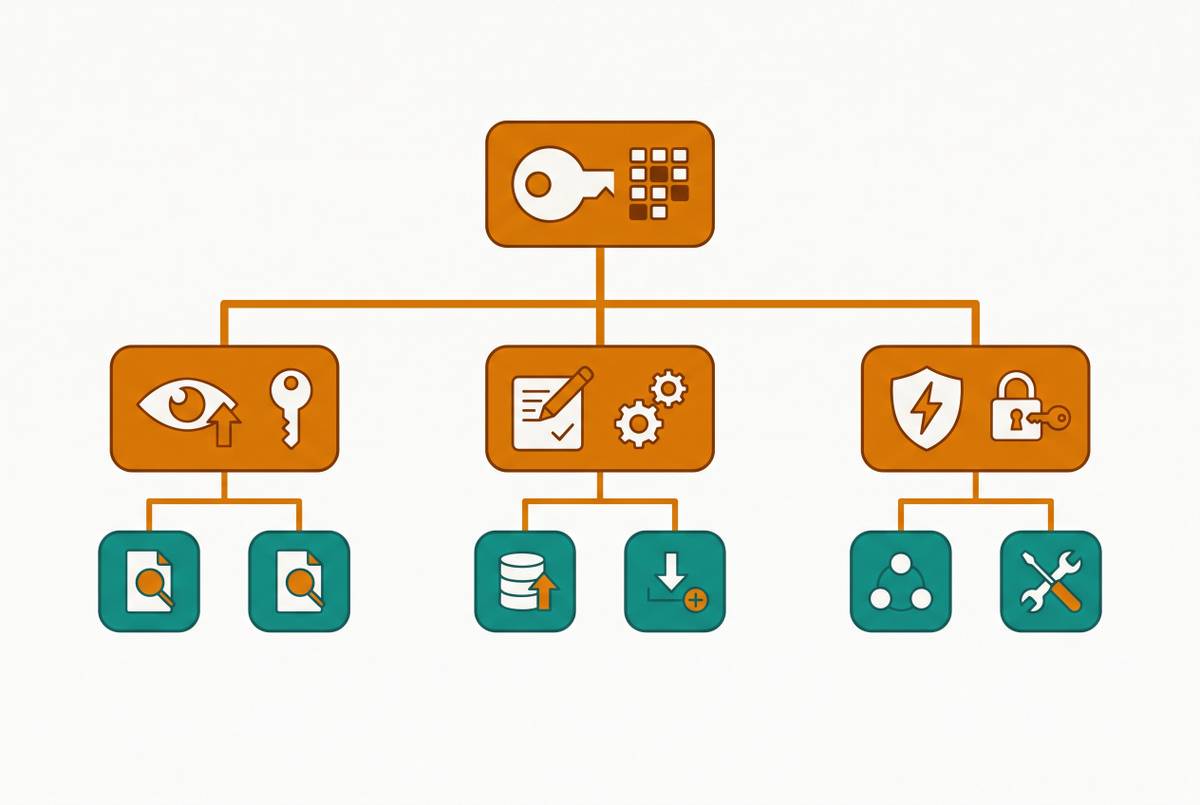
Data Masking Strategies for Non-Production Environments
Masking strategies differ in cost, complexity, and when teams actually use them correctly.
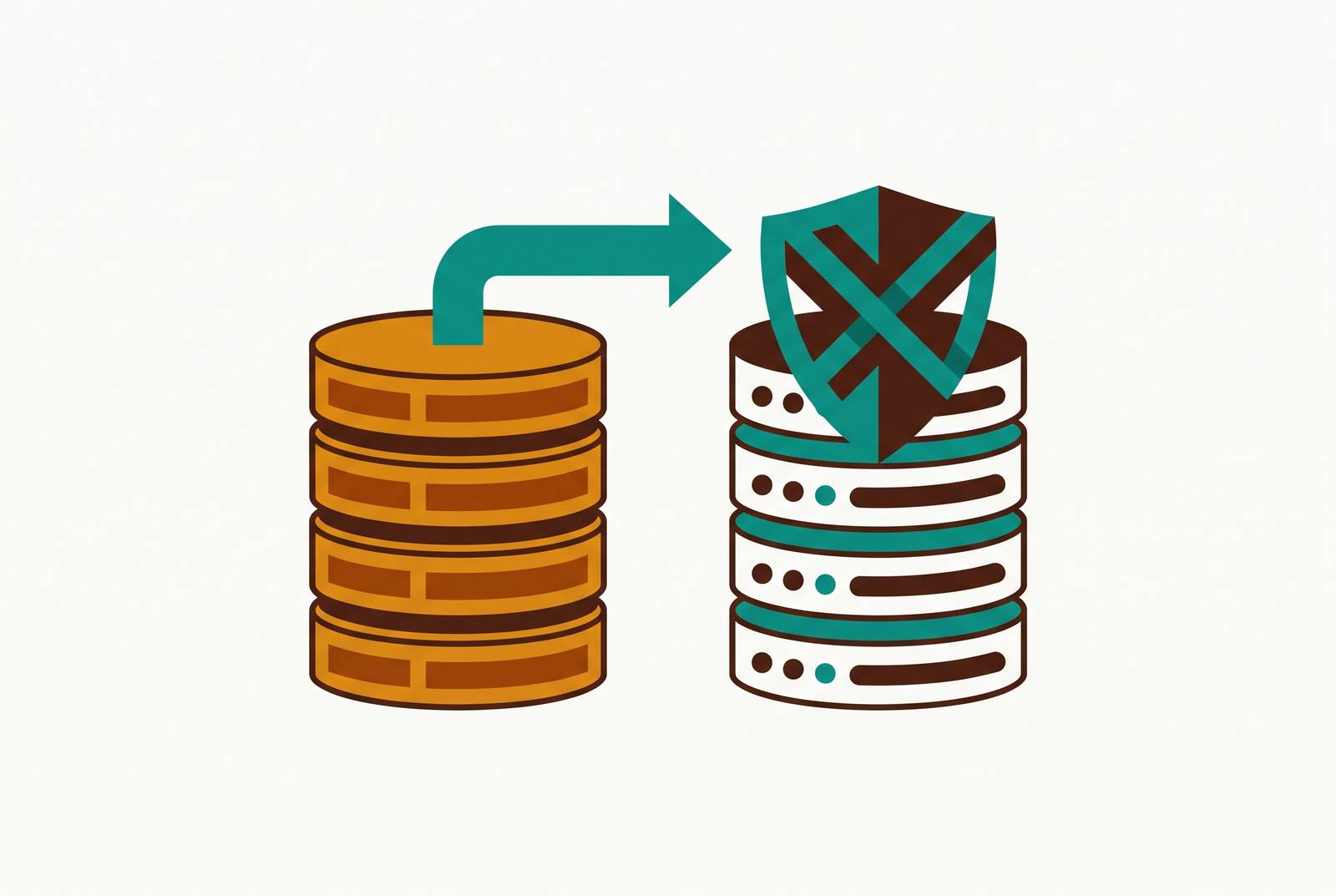
Copying production data into dev, QA, and staging isn't a mistake teams stumble into. It's the rational move. Real data makes tests mean something, bugs show up the way they actually happen, and analytics numbers can be trusted instead of guessed at.
That copy carries the same sensitive data as production, minus the guardrails. Fewer access controls. More shared logins floating around. Less monitoring watching who touches what. The data is just as dangerous, but the lock on the door is cheaper.
And it's not one copy. That means exposure doesn't grow one-to-one with your data footprint. It grows exponentially, because every copy is a new door, and most of those doors are propped open. Over half of organizations, 57%, say the volume of sensitive data sitting in these non-production environments actually grew over the past year. The pile is getting bigger, not smaller.
If one of those copies gets breached, regulators don't care that it was "just staging". The exposed data is identical to what lives in production, so the notification requirements and remediation costs are identical too. GDPR, HIPAA, PCI DSS, CCPA, none of them carve out an exception for test databases. Personal data copied into a QA environment is still personal data. The environment doesn't launder the obligation away; it just makes the obligation easier to forget about until it's too late.
The size of the gap in organizations that have measured it
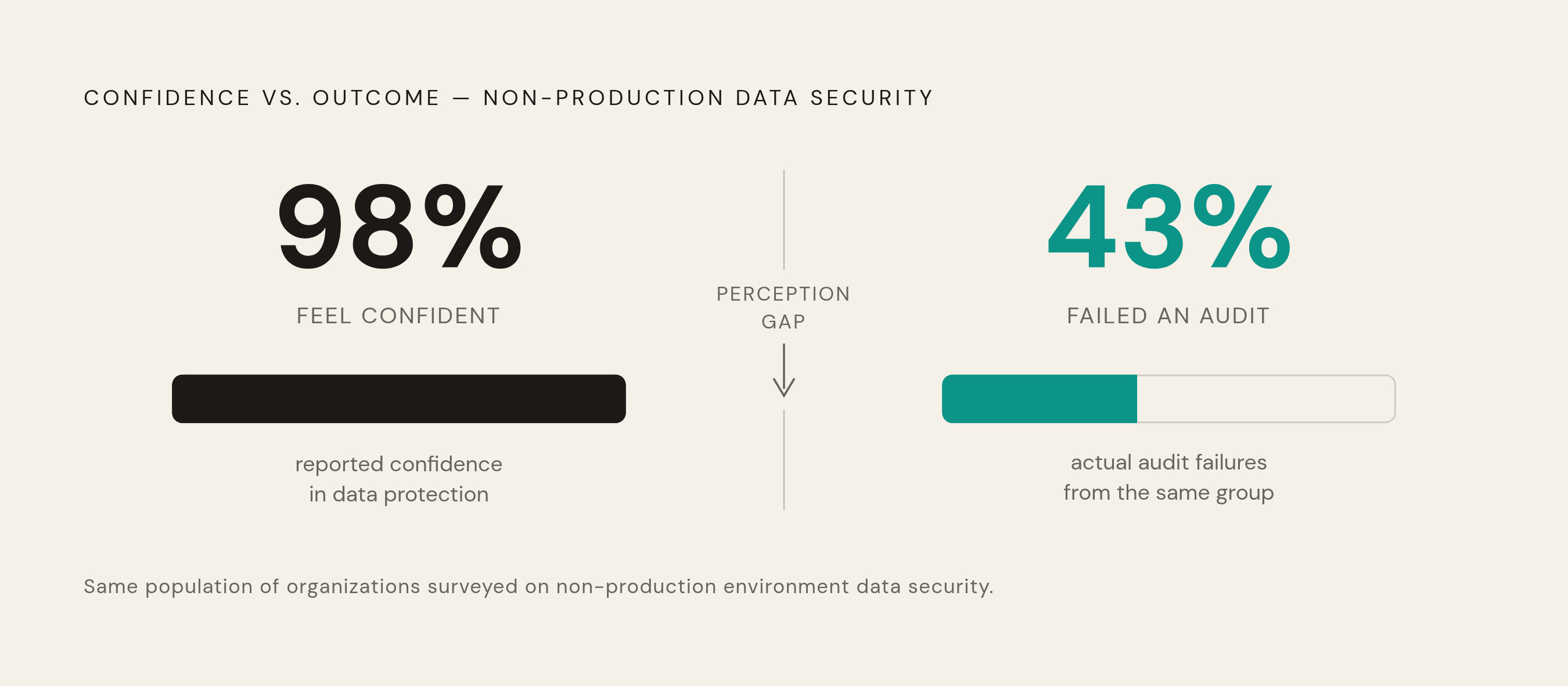
Start with the number that should stop most engineering leaders mid-sentence: 98% of them say they're confident in their ability to protect sensitive data in non-production. Nearly everyone. 43% of those same organizations have already failed an audit, and a meaningful share have already had that same non-production data stolen or breached. That's not a small gap between confidence and reality. That's most of the room being wrong about something they'd bet money on.
How does a gap that wide happen? Look at what organizations are actually doing. A large majority use static data masking to protect sensitive data in their lower environments. Good, that's the right instinct. But most of those same organizations also allow compliance exceptions inside those environments. So the control exists on paper, and then gets waived in practice, probably for the same reasons controls always get waived: a deadline, a contractor who needs quick access, or a "just this once" that becomes the norm.
The pattern holds up across separate research. K2view's 2026 State of Enterprise Data Compliance survey found that most organizations have already had a sensitive-data incident in a lower environment, and only a small fraction of SQL databases stay fully compliant once the data leaves production. Perforce's 2025 report, the year before the one already cited, found a substantial share of organizations reporting breaches or theft tied to non-production environments, and that share had grown year over year. This isn't a one-time finding. It's a trend line pointing the wrong way.
And the cost of getting caught out isn't abstract. IBM's 2025 Cost of a Data Breach Report shows the global average cost of a breach climbing sharply, with a large chunk of that damage traceable directly to sensitive data scattered across non-production systems. Put all of this side by side and the picture is plain: the rule "don't use raw production data in test" isn't a mystery to anyone. The mystery is why so many organizations, confident as they are, keep finding out the hard way that they didn't follow it closely enough.
The four masking strategies and their technical differences
Data masking isn't one technique with different brand names. Synthetic data generation, which builds new fake records from scratch rather than transforming real ones, sits next to this whole category and is growing fast, especially for training AI models. It's a different tool for a different job, so it won't get more attention here, but it exists as an alternative path.
Static Data Masking (SDM) takes a snapshot of the production database, permanently transforms the sensitive columns, and hands over a masked copy. There's no reversing it, no path back to the real values. A customer's name gets swapped for a randomly generated one, a Social Security number becomes a fake-but-valid-looking number, a birth date shifts by some random offset. The copy keeps the same format, type, and relationships between tables, so applications run against it like nothing changed.
Dynamic Data Masking (DDM) works completely differently: nothing gets copied, nothing gets altered. Production stays exactly as it is. Masking happens at the moment a query runs, swapping in fake values before the result ever reaches the user.
On-the-Fly Masking sits in between: it masks data while it's moving, during the transfer from production into a non-production target, rather than after it lands or at the moment someone queries it. No unmasked version ever touches the destination.
Deterministic masking is a technique for preserving referential integrity. The rule is simple: the same input always produces the same output. Customer ID 12345 becomes the same fake ID everywhere it shows up. That consistency is why it's often the default choice for personal data in non-production, because it protects the sensitive value while keeping the dataset usable. Authorized roles, such as application service accounts and DBAs, see real values, while analyst or developer roles see masked output. OvalEdge research identifies three common implementation patterns: native database engine features (e.g., Microsoft SQL Server DDM, Oracle Data Redaction), proxy layers that intercept query results, and centralized policy engines that span warehouses and BI tools.
Static masking: where it fits, where it breaks down
Static masking is the right default when what's needed is a stable environment that gets built once and reused. No ongoing infrastructure, no policy engine humming in the background, nothing to maintain at query time. Build the masked dataset, hand it off, move on.
Testing and QA are the obvious home for this. A masked dataset can live in version control right next to the code, get shared with an offshore QA team or an outside contractor without anyone worrying about what that person can see, and get loaded into a throwaway environment as many times as needed. Analytics built on a fixed historical snapshot fits just as well: reporting on last month's customer behavior doesn't need a live connection to production at all.
But static masking has a shelf life, and it's shorter than most teams expect. The masked copy is frozen at the moment it was made. Production keeps changing after that, so the copy starts drifting from reality almost immediately, and if the schema changes, the masking rules built for the old schema can quietly stop working, sometimes without anyone noticing until a real column full of real names appears unmasked. Masking a large database also takes real computing time, which means refreshing a big masked copy every night isn't realistic without dedicated pipeline work behind it. And because the transformation is one-way by design, there's no fixing a mistake after the fact. Miss a column, mask it wrong, and the only option is to start over from production.
That points to the scenario where static masking simply doesn't work at all: a developer or support engineer needs to debug something happening right now, in production, with the real data behind it. That's a different job, and it needs a different tool.
Dynamic masking: the right tool for production access, not a substitute for static masking in test
Dynamic masking is not a faster, fancier version of static masking. It solves a different problem entirely, and trying to use it as a swap-in replacement for masked test environments misses what it's actually built for.
DDM's whole value is that production data never moves and never changes. That's exactly why it's the right tool when a workflow genuinely needs live production data. Perforce's research shows dynamic masking fits production break-fix work and situations where the actual, current production data is required. It isn't meant to generate the datasets that testing or analytics teams work from day to day. Think of a support engineer chasing down a live billing bug, or a fraud team investigating a transaction that happened an hour ago. Static, day-old masked copies won't show them what's happening right now.
That real-time behavior comes with a cost, though. Because DDM intercepts and transforms data at the moment a query runs, it adds processing overhead right there in the query path. Depending on data volume and how complex the masking rules are, that overhead raises real latency in the query path. This matters before leaning on DDM anywhere near a performance-sensitive production workflow.
DDM's other major job is governing analytics, and this matters more than it might sound like at first. When analysts query production directly, or a production replica, through something like Snowflake or BigQuery, role-based masking set at the database level applies no matter how the query gets made. Masked values come back for analyst roles, real values for the service accounts that actually need them, and none of it requires touching the application code.
The tradeoff that's easy to overlook: DDM policies need upkeep. Add a new sensitive column to the schema and forget to update the masking policy, and that column is now exposed to whoever's querying it, silently, with nothing flagging the gap.
On-the-fly masking and the refresh cycle
Static masking assumes the world holds still between refreshes, weekly or monthly is fine. That assumption stops holding the moment environments refresh daily, or get spun up fresh for every single run of a CI/CD pipeline. At that speed, masking can't be a separate step that happens beforehand. It has to happen inside the transfer itself.
That's the whole idea behind on-the-fly masking: as data moves from production into the target environment, the transformation happens in transit, so no unmasked version ever touches the destination, not even for a second. It's built for data that changes constantly, customer records, transaction logs, anything where a snapshot from yesterday would give a tester a misleading picture of what's actually happening today.
The cost is infrastructure. The masking logic has to live inside the pipeline itself, get watched for failures, and get updated every time the schema changes. That's a heavier lift than static masking's "build it once" model, which is exactly why on-the-fly masking is used only where the refresh cycle actually demands it.
Deterministic masking and referential integrity as the constraint driving technique selection
The simplest way to mask data is to swap every sensitive value for something random. Fast, easy to build, and completely irreversible. It also breaks things in a very specific and very annoying way.
A customer_id of 12345 in the customers table can't just become some random number like 99871 in that one table. Miss that, and foreign keys stop lining up, joins return garbage, and tests start failing for reasons that have nothing to do with whatever bug the test was actually written to catch. Every engineer who's ever debugged a "why is this join empty" ticket for two hours before realizing the test data was the problem already knows this pain, even if they didn't know the cause had a name.
Deterministic masking is the fix. Instead of pure randomization, it uses a mapping function that always produces the same output for the same input, every table, every masking run, no exceptions. The relationships between tables survive intact, which is exactly why it's become the practical default for handling personal data in non-production: it keeps sensitive values out of the dataset while keeping the dataset actually usable for testing.
Consistency cuts both ways. Because the same real value always maps to the same fake value, that mapping is itself a pattern, and patterns can potentially be reverse-engineered if someone can compare masked copies against each other or against other known data. For cases where stronger protection is genuinely required, tokenization or encryption can be layered on top, though both bring their own key management overhead, and encryption in particular brings a reversibility question that has to be governed carefully. The EDPB's 2025 Guidelines on Pseudonymisation get at exactly this: data that's been pseudonymised can still count as personal data under GDPR if re-identification is possible at all, and whether that's the case depends on how reversible the mapping is, who can access the key, and how strong the surrounding safeguards actually are. Deterministic masking solves the engineering problem cleanly. Whether it fully solves the legal one depends on the details of how it's implemented.
Deciding which approach (or combination) fits the situation
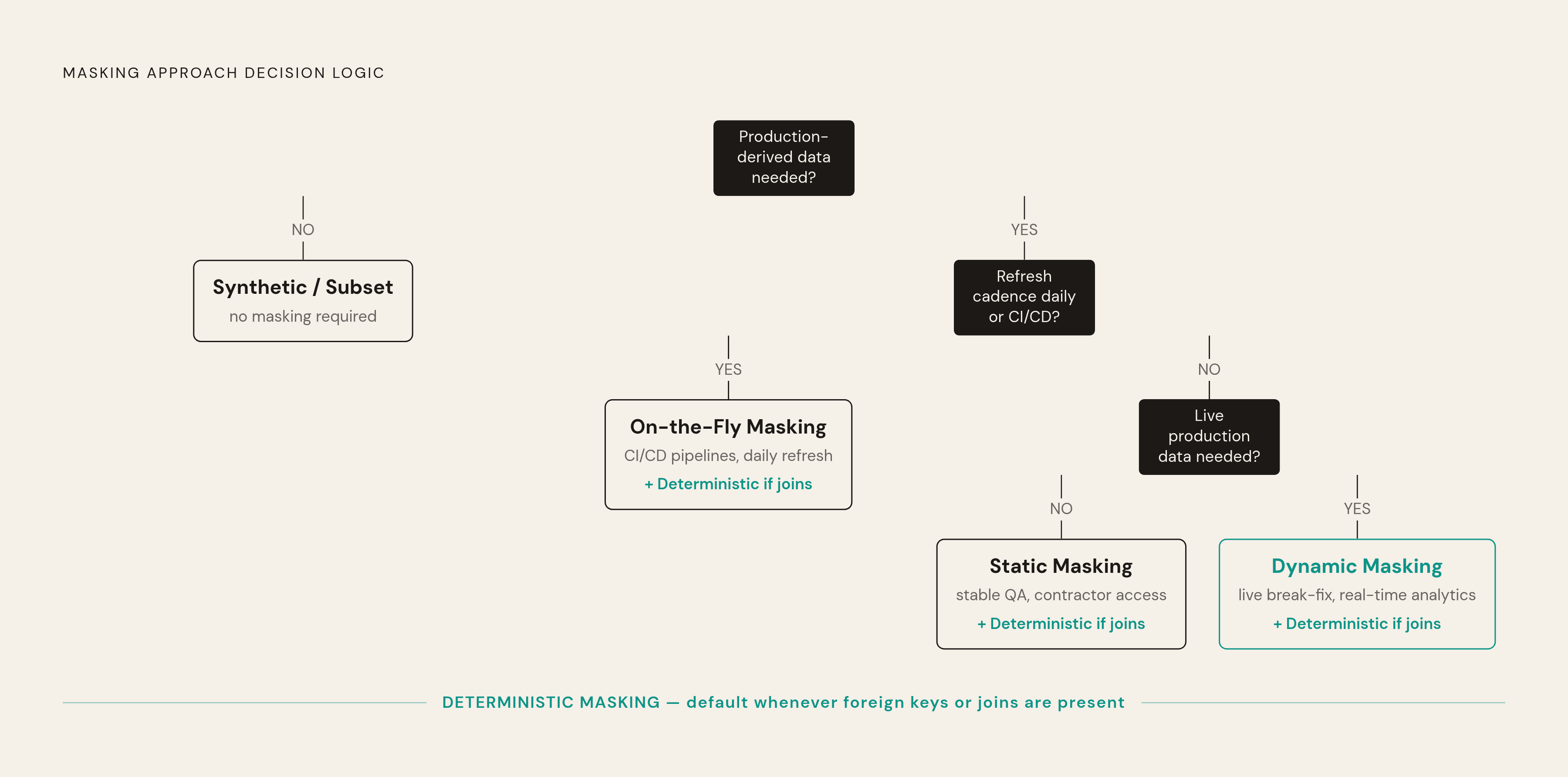
Start further back than the masking technique itself: does this environment need production-derived data at all? A lot of pure unit testing runs perfectly well on synthetic data or a small subset of records, and either one sidesteps the entire masking question by never touching real sensitive data in the first place.
If real, production-derived data is genuinely necessary, the next question is how often the environment refreshes. An environment refreshing daily, or spun up fresh on every CI/CD run, or built against a schema that keeps shifting, needs on-the-fly masking built into the pipeline instead, because a static snapshot simply can't keep pace.
If the actual need is access to live production data itself, not a copy of it, for debugging, a support escalation, or real-time analytics against a production replica, that's dynamic masking's territory, applied at the database or warehouse layer with role-based policies. The masking has to sit at the query layer, not the visualization layer. If the masking isn't enforced underneath all of those paths, it isn't really enforced at all.
And within whichever approach fits, if the data has foreign keys, joins, or relationships that tests depend on, deterministic masking should be the technique running underneath it. That's less a separate decision and more a default worth assuming unless there's a specific reason not to. Masking must be enforced at the query layer, not the UI layer, since BI tool visualization masking alone does not cover exports, API access, or AI-generated queries.
Sources
- Protecting Sensitive Data in Non-Production Environments: No Trade-Offs Necessary! | Perforce Software
- 10 Data Masking Best Practices for Scalable Data Protection
- Only 4% of development and test environments are fully compliant with data privacy requirements, new 2026 survey finds
- Static Data Masking vs. Dynamic Data Masking: What’s the Best Approach? | Perforce Software