Tracking Schema Changes Across Environments With Migration Tools
Detect schema drift before it breaks production deployments across your environments.
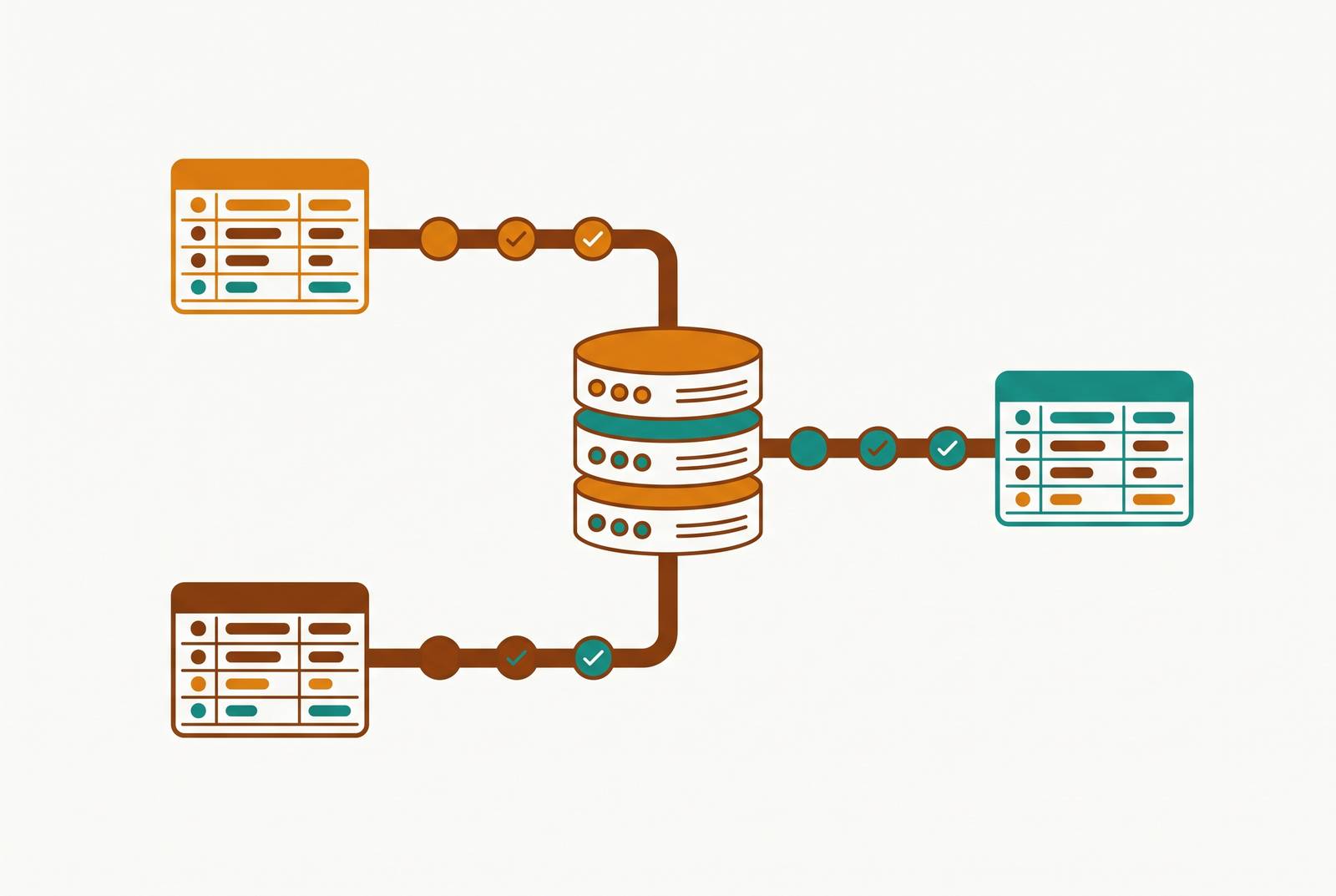
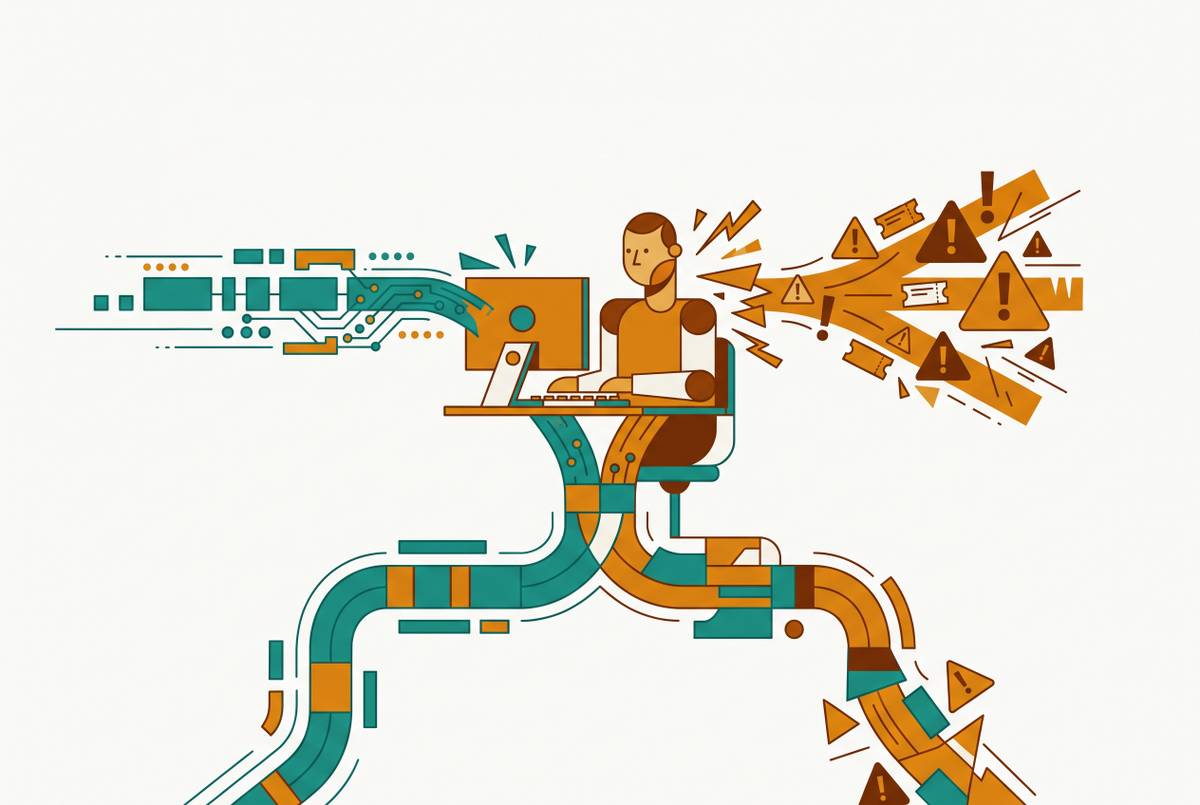
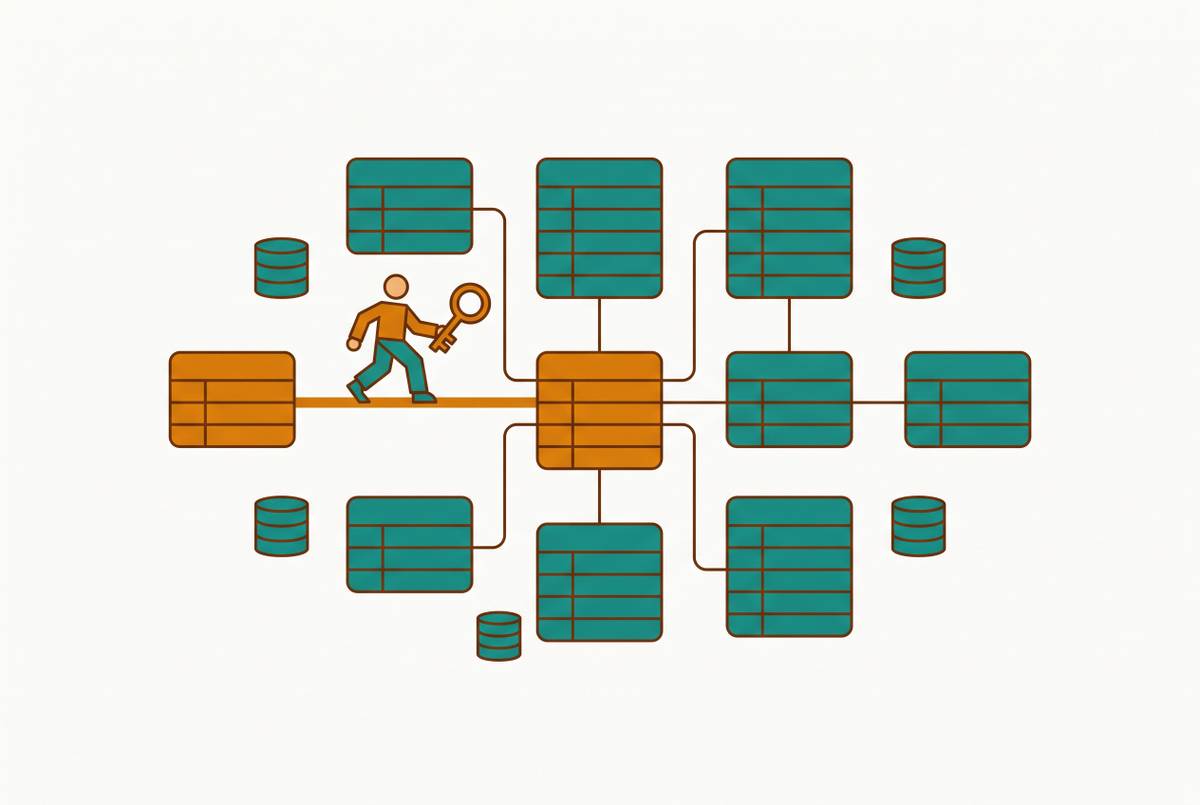
Picture this: a migration gets applied to staging. Somebody decides it's the wrong call, reverts it in the branch, and moves on. Except the database itself never gets touched. Six months pass. A deployment fails on production and succeeds everywhere else, and not one person on the team can explain what's different between the two environments. That's schema drift, and it's the actual problem every migration tool on the market is trying to solve.
A migration is deliberate. Nobody plans drift. It accumulates in the gaps between planned changes, and by the time it causes a problem, the person who caused it has usually forgotten it happened.
The damage rarely appears as a dramatic crash. Data gaps open up and sit there until a downstream analyst or a finance lead asks a question the data can no longer answer. This is exactly where self-serve analytics tools get exposed. When that assumption breaks silently, the tool doesn't fail loudly, it just starts giving confidently wrong answers.
Start from the failure mode you're most afraid of, not from a list of tool names. Every section that follows comes back to this same question: what are you actually protecting against?
Versioned migration CLIs: tracking what has run and detecting changes
The oldest and most widely used approach treats every schema change as a file. Each file is numbered, ordered, and checked into version control, and the database keeps a record, inside itself, of exactly which files it has already applied. That record is the whole mechanism.
Flyway applies numbered SQL files in sequence and logs each one in a schema history table. That single rule forces people to add a new step on top of history, closing off the most common source of drift. Liquibase goes a step further with its diff and diffChangeLog commands, which can compare two live databases directly and write the difference back out as new changesets, giving teams a built-in path to catching drift as it happens.
Ask any database which migrations it has received and compare that list against another environment; any gap is right there in front of you.
But the approach has a real ceiling. It tracks what has run through the pipeline. It does not automatically catch what happened outside the pipeline. Flyway is built as a versioned migration tool, not a diff tool. Generating a diff between two live databases sits behind Flyway's paid tier, so teams on the free version lean on pipeline discipline to prevent drift rather than any automated check that discovers it after the fact. Liquibase's diffChangeLog is a genuine drift-detection path, but someone has to run it. It's not watching continuously in the background.
So versioned CLIs are strong when the pipeline is the only door into the database. They get weaker the moment someone finds a side door. Two developments matter here for anyone evaluating these tools today: Flyway 13.9.0 shipped on October 1, 2026, and the 13.x line added an MCP server for AI agents, with Flyway 12.9.0 earlier sharpening CI/CD behavior through distinct exit codes and drift-resolution controls. Separately, Redgate discontinued the Flyway Teams tier for new customers on May 14th, 2025, leaving just Community and Enterprise. That collapses the mid-market option entirely, forcing teams to pick between the free community edition or a jump straight to enterprise pricing.
Declarative schema-as-code tools: enforcing state instead of tracking changes
Versioned CLIs leave a gap: drift that occurs outside the migration pipeline goes undetected until someone runs a manual check. Declarative tools close that gap by changing what the source of truth even is.
Instead of tracking a sequence of changes, a declarative tool defines the schema as a single state, a file describing what the database should look like, and figures out the steps needed to get there. Atlas is the clearest example: the schema is written in HCL or plain SQL, and Atlas computes a migration plan to reach that defined state, the same way Terraform plans infrastructure changes before applying them. The mental model shifts from "what sequence of steps got us here" to "what should be true right now," and that shift makes drift detectable by simple comparison, checking the file against any live database.
Skeema takes the same declarative approach but stays narrower, working only with MySQL and MariaDB, not Postgres. Atlas itself isn't locked into one paradigm either: it supports a versioned mode through atlas migrate diff and atlas migrate apply, so a team can run declarative schema management locally while still working in a versioned style inside CI.
None of this removes the need for judgment. A generated diff still needs a human to look at it before it touches production. A tool can compute "add NOT NULL column" without knowing whether the existing table has rows that would violate that constraint the moment it's applied. Atlas's atlas migrate lint catches some of the riskier patterns, an unconditional NOT NULL addition, for instance, before it ships, but anything involving moving or backfilling data still needs a person paying attention.
This is the honest objection from people who prefer hand-written scripts: a script someone wrote is intentional and auditable, while generated DDL can surprise you with a statement nobody explicitly typed. That's a fair concern. Declarative tools surface the change in a plan preview before anything reaches the database, the same way terraform plan shows the proposed changes before an apply goes through. The review hasn't disappeared. It's just moved to a different point in the workflow.
ORM-integrated migrators and schema tracking in application code
Some teams never write schema as a standalone SQL file. The schema is defined inside application models, and the migration tool reads off those models directly. Prisma Migrate is a clear example: Prisma's own documentation describes it as a database migration tool available through the Prisma CLI that integrates with the Prisma schema for data modeling and generates SQL migration files straight from that data model.
Binding the schema to the application code this way closes off a specific kind of drift: the model and the migration can no longer quietly diverge from each other, because they're generated from the same source. That's a real benefit. But it trades one dependency for another. ORM-integrated migrators are tied to a single language ecosystem, and auto-generation carries blind spots. A Prisma-generated migration can't express everything PostgreSQL is capable of, so a team that needs engine-specific DDL often ends up hand-writing raw SQL migrations to sit alongside the generated ones anyway.
The dbt ecosystem offers a useful adjacent case, even though dbt isn't a schema migration tool in the same sense. dbt model contracts, when enforced in CI with enforced: true, will fail a model's build the moment its output no longer matches the declared shape. That failure appears inside a pull request, not inside a dashboard three weeks later when someone notices the numbers look wrong. That's a genuine reduction in the cost of refactoring a schema that data pipelines depend on.
The large-table problem and the limits of all three approaches
None of the three approaches above actually solve one specific problem: a standard ALTER statement locks the table it's modifying. On a small table that lock lasts milliseconds and nobody notices. On a large, actively-written production table, that same lock can hold for minutes, and during those minutes, the service built on top of it can go down. Tracking a migration carefully doesn't make the underlying ALTER statement safe to run.
Vitess, the MySQL clustering system that runs underneath companies like Slack and GitHub and is maintained by PlanetScale, takes its own architectural approach to the same problem: online DDL strategies, using either its built-in VReplication or external tools like gh-ost, let schema changes apply with minimal or no downtime, though a migration step is still required somewhere in the process.
Online DDL tools sit next to migration tools, not inside them. A migration file can call out to gh-ost or pg-osc as part of its execution, but the migration tool itself isn't the thing performing the online schema change. Knowing when a table is big enough and busy enough to need that extra layer is a judgment call that belongs to the engineer running the deployment, not something any of the tools above will flag automatically.
Governance platforms: review and approval on top of any migration workflow
Everything covered so far solves a technical problem: getting the schema change applied correctly and tracked accurately. None of it guarantees that a human being with the right context actually looked at the change before it reached production. That's a separate, social failure mode, and it's what governance platforms exist to close.
Bytebase is the clearest example of this category. It adds SQL review, approval flows, and audit trails on top of either a versioned or a declarative workflow underneath it. It runs as a server rather than a CLI tool, which makes it heavier to operate day to day, but that same architecture is what lets it enforce policy across an entire team instead of depending on each individual engineer remembering to follow the rules.
Compliance work is where this matters most concretely. Teams for whom tested rollbacks are a genuine compliance requirement need to check this specifically.
A related shift changes what counts as part of a migration. Starting October 30, 2026, new tables in Supabase's public schema will no longer be automatically exposed to the Data API. Permissions are becoming part of the migration artifact rather than a parallel workflow handled separately, and tools that still treat the two as unrelated steps leave a gap exactly where this trend is closing one.
Using a database GUI as a starting point for schema visibility
Plenty of teams haven't adopted any of the tools described above yet. Their schema changes happen through a GUI client, DBeaver, DataGrip, Navicat, pgAdmin, someone opens a connection, runs an ALTER statement by hand, and closes the window. For a true one-off change, that's not an unreasonable way to work. But it leaves nothing behind: no change history, no propagation to other environments, and no way to detect drift after the fact, since no record exists to compare against.
The gap isn't only a technical one. When an engineer changes the schema through a GUI session, nobody outside engineering, not product, not sales, not support, has any visibility into what changed or whether it affects the numbers they're looking at that day. The change simply happens, and everyone downstream finds out when something looks wrong.
What a small engineering team actually needs is two things working together, not one tool trying to do both jobs. First, a migration tool that tracks changes and gates what reaches production, which is what every section above has been describing. Second, a database GUI or BI layer that gives the rest of the company safe, self-serve access to the result, without requiring a dedicated data team or a full BI stack to maintain it. The migration tool answers "what changed and was it reviewed." The visibility layer answers "can the rest of the company see what it means."
Choosing a migration tool approach by the failure mode you are most trying to prevent
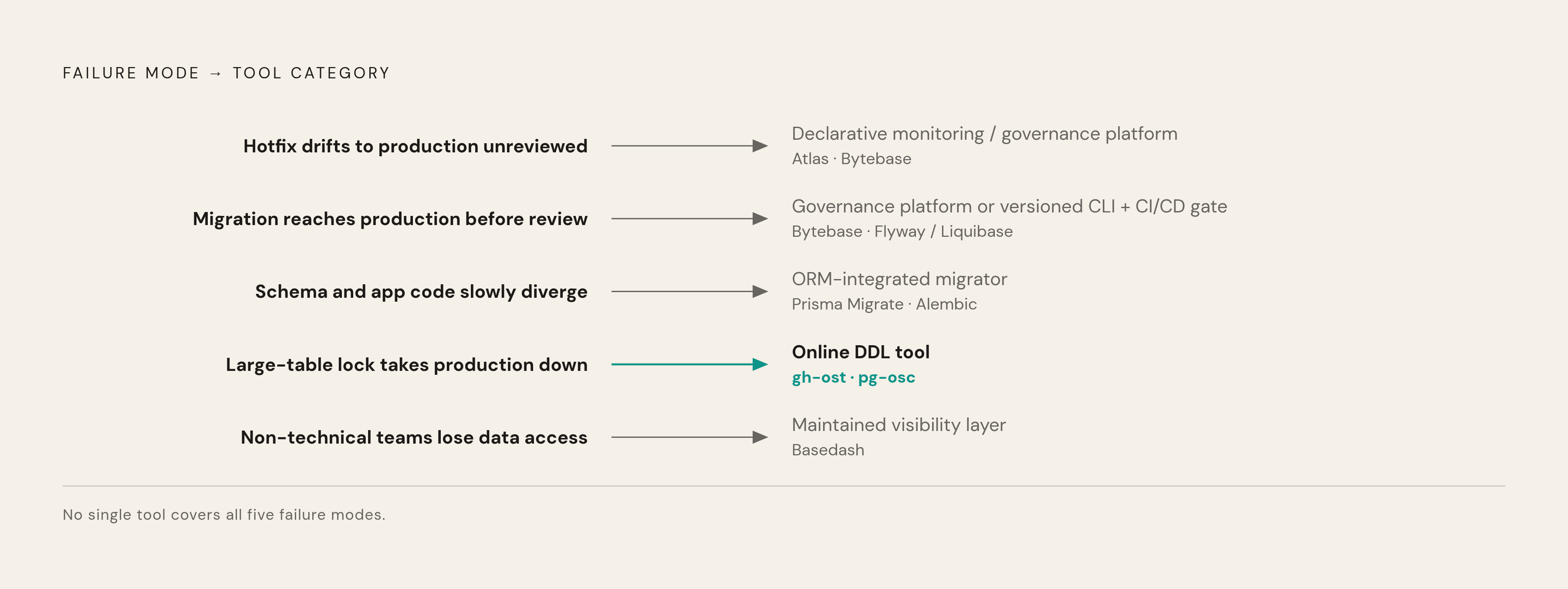
Every approach covered here solves a different version of the same underlying problem, and the right choice depends entirely on which failure keeps a team up at night. If the fear is an unreviewed hotfix quietly drifting into production, a declarative tool with continuous schema monitoring, Atlas being the clear example, or a governance platform with approval flows built in, like Bytebase, addresses that directly, while a versioned CLI without drift detection still relies on individual discipline. If the fear is a migration reaching production before anyone reviewed it, the right layer is either a governance platform like Bytebase or a versioned CLI such as Flyway or Liquibase with CI/CD gating and enforced approval steps built into the pipeline, since declarative tools that auto-apply on diff don't solve this problem without additional controls wrapped around them. If the fear is schema and application code slowly diverging from each other, an ORM-integrated migrator, Prisma Migrate or Alembic, keeps both living in the same codebase under the same review, where standalone migration tools require a separate, deliberate discipline to keep the model and the migration in sync. If the fear is a large-table lock taking production down mid-release, online DDL tools like gh-ost or pg-osc are the actual answer, because no migration tracking tool solves that problem on its own; Sentry's two-phase deployment pattern is a concrete, workable model for combining migration tooling with online DDL safely rather than treating them as substitutes for each other. And if the fear is non-technical teams losing trustworthy access to the data once a schema change lands, the migration tool matters less here than whether the data layer sitting above the schema, dashboards, saved queries, the tools people actually open every day, gets maintained in step with the migration; Basedash's direct database connection means schema changes surface immediately in the tools non-technical teams already use, without a separate data team needing to rebuild reports by hand after the fact.
Two things cut across every approach above, regardless of which one a team picks. And a team with no migration tool at all isn't actually starting from zero. The first real step is making the ordering and the review that already exist explicit, so there's finally something to track, rather than adopting the most sophisticated tool in the category.