Retool vs Appsmith vs Tooljet for Internal Database Apps
Which internal tool platform scales to your team's actual size without breaking your budget.
Start with what each tool is actually for, because that explains everything else down the line.
Retool lets engineering teams build internal admin panels and dashboards on top of existing databases and APIs in hours instead of weeks. It's proprietary, cloud-first, and has the most polish of the three right out of the box. It also has the biggest market share, and there's a reason for that: most teams underweight how much time a good-looking component library saves in the first month, then overweight it once the bill arrives two years later.
Appsmith is open-source (Apache 2.0 license, roughly 36,000 GitHub stars as of mid-2026) and built for developers first. Using it feels a lot like building an admin panel with a popular frontend framework, minus most of the boilerplate. Teams pick Appsmith when they want Retool-like power without the vendor lock-in that comes with it.
ToolJet is also open-source (AGPL v3, over 38,000 GitHub stars), and it pitches itself as enterprise-grade governance plus open-source flexibility. Version 3.20 is among its recent releases. The thing that sets it apart on paper: AI sits in the core product, not bolted on as an afterthought.
All three cover the same basic jobs: custom CRMs, admin panels, customer success dashboards, onboarding tools, data-editing screens sitting on top of production databases. The real split is philosophical. Retool is proprietary and bets on speed and shine. Appsmith and ToolJet are open-source and bet on control, predictable cost, and never getting stuck with one vendor.
Here's the thing nobody's landing page will tell you: none of these three are built for "citizen developers." All three expect you to know JavaScript. If the person building your app isn't technical, expect a steep climb no matter which one you pick. Anyone selling you on drag-and-drop as a replacement for an engineer is selling you something.
How database connectivity and integration breadth differ across the three
For a team on a standard stack, this section barely matters. All three natively support a relational database, a document database, REST APIs, and GraphQL, which covers most companies. The differences show up at the edges, and the edges are where teams get burned.
Appsmith's connector list runs long: Postgres, MySQL, MongoDB, Microsoft SQL Server, MariaDB, Amazon Redshift, DynamoDB, Snowflake (with key-pair auth added in 2025), REST API, GraphQL, Google Sheets, Salesforce, and a range of other services. Anything off that list needs a manual REST API setup, and that eats time.
ToolJet claims more than 100 native integrations, plus support for custom connectors written in JavaScript or Python. It also ships with a built-in relational database, so a team can start building before wiring up anything external.
Retool sits around 50-plus integrations, but its native connectors for common tools like Stripe, Jira, and Salesforce save real setup time compared to the REST workaround Appsmith often needs for the same job.
Component depth follows the same pattern: Retool offers more than 100 pre-built UI components, ToolJet more than 80, and Appsmith's library is comparatively narrower. That gap shows up fast when a team is trying to prototype a complex data view quickly.
Language support inside the builder is a quiet but real differentiator. Retool supports JavaScript (Python mostly lives in its workflows product). Appsmith is JavaScript only. ToolJet supports both, in the builder and in automations.
Appsmith does win one point outright on developer experience: its editor has built-in autocomplete, multi-line editing, debugging, and linting. ToolJet's editor doesn't match that yet.
And Retool and ToolJet both ship a built-in relational database. Appsmith doesn't, which is a real friction point if a team wants to prototype fast without standing up its own database first.
Where UI flexibility and customization actually diverge
Retool leans hardest into drag-and-drop, and it shows. Out of the box, it's the most polished of the three. Custom code is possible, though teams that want the deepest scripting control will generally find Appsmith's approach gives them more latitude. Retool suits a team that wants to ship fast and doesn't want to burn hours on styling.
Appsmith goes further into code. Its scripting-based customization gives fine-grained control over how components behave and how layouts work. It suits a team that wants more control and doesn't mind writing more of it.
ToolJet pairs its visual builder with JavaScript and Python logic, and adds two things neither competitor has built the same way: real-time multiplayer editing, and AI-native app generation straight from a plain-language prompt, both part of the core product, not an upsell.
Mobile is where Retool pulls ahead cleanly. Its native mobile builder, launched in early 2024, produces actual native iOS and Android apps. Appsmith and ToolJet both offer responsive web apps that work fine in a phone browser, but neither has a dedicated native mobile build path. If mobile matters to your product, this gap is significant.
Branding is close to a wash. All three let you drop in a custom logo, colors, and fonts. Appsmith requires at least its Business plan ($15 per user, per month) to remove its own branding.
Git integration and version control show up on all three, but the mechanics differ. Retool's self-hosted release cycle deliberately lags its cloud release, so self-hosted teams are always running behind the current cloud version. Appsmith's self-hosted builds share version numbers with cloud, but cloud users get automatic upgrades while self-hosted users upgrade by hand.
One practical note that applies to all three: they run in the browser, and they can all strain under data-heavy apps. Before committing to any of them for a serious analytics dashboard, test it against real data volumes, not a demo dataset.
How pricing models create fundamentally different cost curves at scale
This is where the three platforms stop looking like variations on the same product. Pick wrong here, and it stops being a tooling problem. It becomes a budget problem.
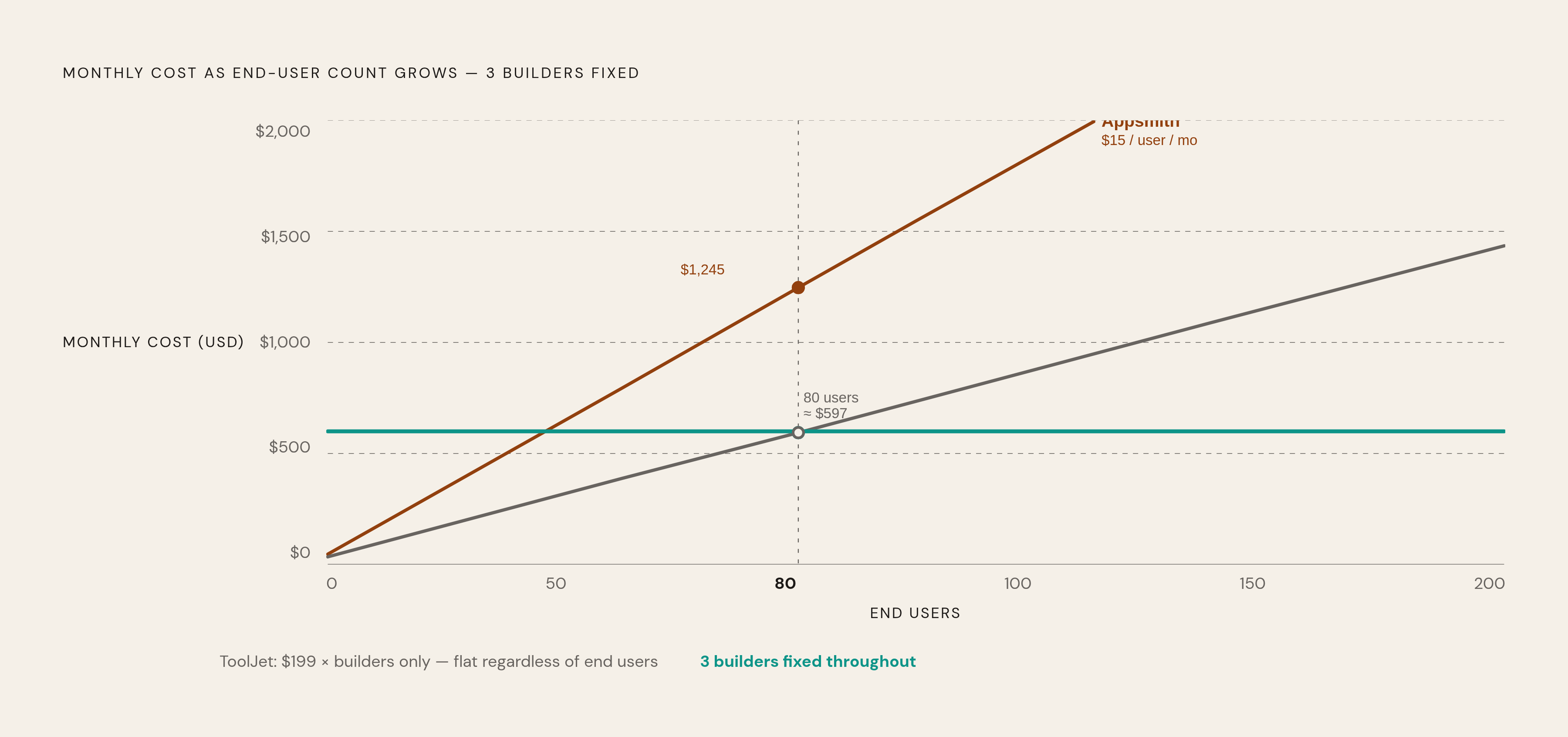
The structural split: Retool charges for builders and end users both. ToolJet charges for builders only. Appsmith's cloud tier charges per user across the board, end users included, at $15 a month each.
Retool's tiers (2026):
- Free: up to 5 Standard Users and 5 End Users, 500 workflow runs a month, 5GB storage, 250 AI credits. No staging environments, no audit logging.
- Team: $12 per builder, per month, plus $7 per internal user, per month.
- Business: $65 per builder, per month, plus $18 per internal user, per month. Paying annually knocks off roughly 20%.
- Retool's own Business Annual pricing shows 5 builders and 10 internal users landing at a $400 monthly equivalent, or $4,800 paid up front for the year.
- External users are charged at $8 a month each from 51 to 250, $6 from 251 to 500, $4 above 500. That rate took effect September 13, 2025.
- Self-hosting is Enterprise-only, custom priced. There's no fixed self-hosted rate on any lower tier.
Appsmith's tiers (2026):
- Free (cloud): up to 5 cloud users, with limited features and no paid governance controls.
- Community Edition (self-hosted): Apache 2.0 license, free, unlimited users and apps.
- Business: $15 per user, per month, for every user type, end users included, up to 99 users. Unlimited repos, environments, and workflows, plus audit logs and custom roles. Cloud hosting isn't automatic on Business; only Free gets it by default.
- Enterprise: starts at $2,500 a month, covering roughly 100 users, adds SAML/OIDC, SCIM, and additional enterprise controls.
ToolJet's tiers (mid-2026, per a May 2026 teardown):
- Free: 2 builders, 50 end users, 2 apps, and a limited AI credit allocation per month.
- Starter: $19 per builder, per month (20% off paid annually).
- Team: $199 per builder, per month, with unlimited end users and apps, SSO, Git sync, audit logs. This is the realistic production tier for most companies.
- Enterprise: custom pricing, adds SCIM, custom AI models, air-gapped self-hosting.
- One wrinkle: ToolJet's own blog lists a different Business plan price ($24 a month per builder) elsewhere, a sign that plan names and prices moved around across 2025 and 2026. The May 2026 teardown is the more current source.
- Self-hosting is available on Free, Pro, and Team, not just Enterprise. Starter is cloud-only. Air-gapped self-hosting is Enterprise-only.
Here's where the math actually breaks: a team with 3 builders and 80 internal users looks nothing alike on Retool, where the per-user charge hits all 80 people, versus ToolJet, where only the builders count. One team posting on r/SaaS described their Retool bill climbing from $50,000 to $1,000,000 a year as their user count scaled up. One bad contract doesn't explain a jump like that on its own. That's what a dual-seat pricing model does by design, once a tool stops being "internal" and starts being something the whole company logs into.
If your internal tool is going to spread past a couple hundred people, per-seat-on-everyone pricing should scare you more than any feature gap in this piece. Self-hosting is the escape valve. Appsmith's Community Edition and ToolJet's lower tiers are both self-hostable with no per-user fee. Retool's self-hosting only exists inside an Enterprise negotiation, and that tells you exactly what Retool thinks that escape valve is worth.
Governance, security, and what's actually paywalled on each platform
At the certification level, this is close to a tie, with one gap. Retool and ToolJet both carry SOC 2 Type II and ISO 27001, plus GDPR compliance. Appsmith has SOC 2 Type II and GDPR too, but doesn't publicly document an ISO 27001 certification.
Where things actually split is what's paywalled, and ToolJet quietly wins this one.
On Retool, SSO and audit logs sit behind Business or Enterprise. Granular role-based access control is a Business feature. Full enterprise governance, things like SCIM, needs an Enterprise contract.
On Appsmith, audit logs and custom roles come with Business ($15 per user, per month). SAML/OIDC, SCIM, and CI/CD all require the $2,500-a-month Enterprise entry point. Beyond basic access, free-tier governance features are limited.
ToolJet stands out here: SSO, granular RBAC, and audit logs are all available without hitting an Enterprise wall. They're part of the Team plan. Only SCIM and custom AI models sit behind Enterprise. Of the three, ToolJet paywalls the least governance, and that matters a lot more than it sounds like it should if your company runs a security review before anyone touches a database.
For teams building client-facing or multi-tenant apps, the picture shifts again. Retool has a dedicated external-user pricing tier (that $8-a-month rate from 51 to 250 users) and a built-in email invitation flow. Appsmith has an invitation UI too, but self-hosted instances need a third-party SMTP provider configured just to send those invitation emails, and there's no dedicated external-user pricing tier at all. Anyone building a client portal needs to weigh that against Retool's external-user cost curve directly.
Air-gapped deployment is available on all three, but the plan level differs. ToolJet offers it broadly across paid plans. Retool and Appsmith both save it for their top-tier contracts.
For regulated industries (finance, healthcare, defense), this section decides the whole question. Retool's SaaS-only stance on its lower tiers is a hard blocker for any team that can't sign an Enterprise deal. Appsmith's self-hosted Community Edition and ToolJet's self-hosting on every plan both remove that blocker without an Enterprise contract at all.
AI capabilities built in versus bolted on
ToolJet leans hardest into this, and it's not close. Natural-language app generation and an agent builder are both part of the core product, and it supports multiple LLMs, including OpenAI, Anthropic, and Gemini. AI is a first-class layer here, built in from the start instead of stitched on after the fact.
Retool AI, by comparison, focuses on code suggestions, component generation, and query optimization inside existing workflows. It doesn't offer autonomous agent capabilities right now, and its workflows stay fundamentally linear. AI here speeds up what a builder is already doing. It doesn't generate something new on its own.
Appsmith's AI capabilities are the thinnest of the three right now, with no native agent builder in the current product.
The deeper risk worth sitting with, and the reason "AI built in" beats "AI bolted on" as a long-term bet: wiring AI onto a proprietary platform tends to produce integrations that age badly as the underlying models keep changing. Open-source platforms that support multiple LLMs can swap in whichever model performs best as the landscape shifts, without waiting on one vendor's roadmap. That's the difference between choosing your own upgrade path and being handed one.
For a team not yet building AI-native tools, none of this poses an immediate blocker. But it's worth asking where that team wants to be in 18 months, not just where it stands today.
Which team profile fits each platform best
Retool fits a team that:
- Wants the fastest path from zero to a working internal tool, and has the budget to pay for that speed as headcount grows
- Needs native mobile apps, not just a responsive web view
- Is fine staying inside an Enterprise contract if self-hosting ever becomes a requirement
Appsmith fits a team that:
- Wants open-source flexibility under Apache 2.0 and heavy customization through JavaScript, without vendor lock-in
- Needs self-hosting at no per-user cost, and an Enterprise contract isn't in the budget
- Values a strong editor experience, since Appsmith's autocomplete, multi-line editing, linting, and debugging genuinely help anyone who lives in the query editor all day
- Prefers community-driven support over a dedicated enterprise support line
- Can live with no built-in database and can handle SMTP setup for self-hosted invitation emails
ToolJet fits a team that:
- Wants SSO, RBAC, and audit logs without paying Enterprise prices for them
- Is building, or planning to build, AI-native tools and wants that layer baked in instead of bolted on later
- Needs self-hosting flexibility across more than just the top-tier plan
- Has builders split between JavaScript and Python and doesn't want to force one language on the whole team
None of the three is a universally correct answer, but the math isn't a mystery either. Count the real numbers: how many builders, how many end users, whether the database is standard or unusual, whether self-hosting is a requirement or a preference. Do that math before comparing feature lists, and the decision tends to make itself. Skip it, and the decision gets made for you, usually around the time the invoice shows up with a number nobody budgeted for.