Risks of Sharing Database Credentials Across Team Members
Shared passwords destroy audit trails and multiply breach damage when employees leave.
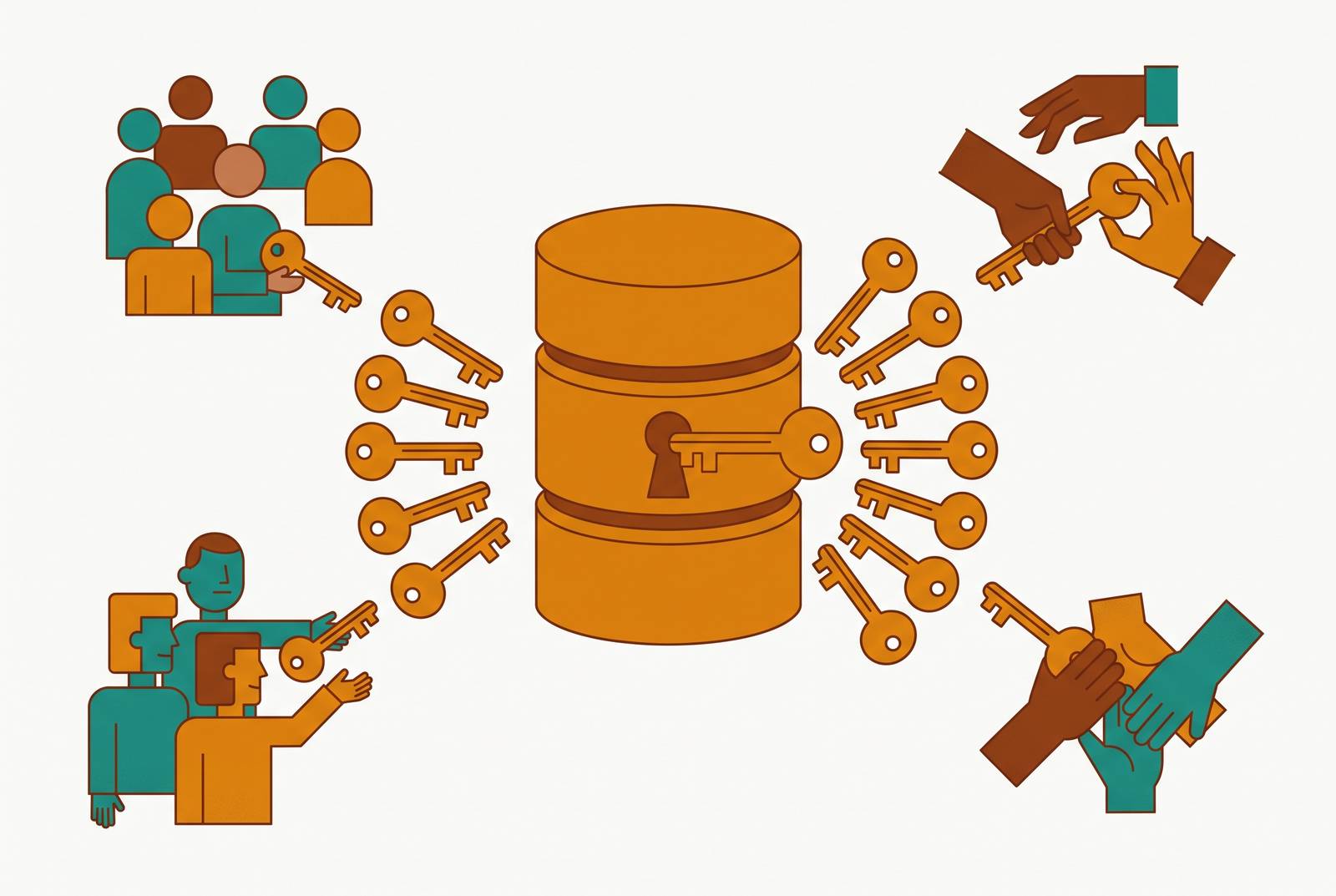
A developer gets a database password dropped into a Slack message. A contractor is emailed an admin login on their first day. A finance team keeps a payroll credential sitting in a shared spreadsheet that three people have edit access to. Every one of these handoffs is informal, none of them gets tracked, and none of them is ever revoked by default.
None of this happens because teams are careless. It happens because the secure alternative, provisioning a proper individual account, requesting the right permission level, waiting for approval, is slower than the task sitting in front of someone right now. A deadline doesn't wait for an access request ticket. So a password gets forwarded instead, and the work gets done.
Sharing a credential is often the rational choice, given the options actually available to the person making it. The formal process is slower than the informal one, so people route around it. This is a structural condition that a security awareness email cannot fix. It's a structural condition, built into how access gets requested and granted, and it appears the same way across engineering teams, finance teams, and any non-technical group that just needs to pull a report. Every risk covered from here forward traces back to that same structural gap: the secure path costs more time than the insecure one, so the insecure one wins by default.
How shared credentials destroy the audit trail
The first casualty of a shared credential is the record that would let anyone figure out what happened after a breach.
When a password moves through a chat app, an email thread, or gets read aloud over a call, there's no log of who's holding it at any given moment. Five people using the same login means an incident response team has no way to determine which of the five caused a breach, because the system only ever recorded one identity doing the work of five.
This cuts deeper than logging. Security monitoring tools work by building a baseline of normal behavior for a given account, then flagging deviations from it. A shared account has no single behavioral baseline to deviate from because it behaves like an average of five people rather than one. Unusual activity from any one of those five people blends into what already looks like a noisy, multi-user pattern, and the anomaly that should trigger an alert simply doesn't stand out.
The deeper issue is architectural. Sharing a credential doesn't transfer ownership of it, so there's never a moment where accountability for that access actually lands on a specific person. Passwork's guide lays out the mechanics: the credential lives somewhere outside the vault, an inbox, a chat history, a screenshot, and revoking it means manually rotating the password across every system it touches, because there's no single point of control left to pull.
The practical fallout appears the moment something goes wrong. Instead of pulling a timestamped log and tracing exactly who did what, incident response turns into reconstructing events from memory, Slack scrollback, and guesswork about who still had the password that week.
Shared credentials as an organization-wide attack surface
Losing the audit trail is the quiet version of this problem. The active version is worse: a single shared credential doesn't just hide what's happening, it multiplies how much damage one leaked password can do.
Credential stuffing is the clearest example of the mechanism at work. Attackers take leaked username and password pairs and run them through automated tools that test the same pair against hundreds of services at once. A password reused across systems, which happens when a credential is shared and copied into multiple places, lets one leaked pair unlock every service where that password was ever used.
Shared admin credentials make this worse in a second way. Everyone holding the credential inherits the same elevated access, regardless of what their actual job requires. That means a single compromised holder, out of however many people share the login, hands an attacker full admin exposure across every system that account can reach. The access level was never scoped to the person, only to the credential.
Interception adds a third angle. A password sent over chat or email isn't a hash sitting in a database, it's a live, usable string of characters, and anyone who intercepts that channel gets a working key. Every system that credential reaches is now inside the blast radius.
Vendors and contractors extend that radius past the organization's own walls. A credential shared with a third party means a breach at that third party becomes a breach at the organization that shared it. And because shared accounts don't carry an individual behavioral baseline, an attacker who gets in through one of these routes can often stay in for months without tripping an alert, since persistence is the default outcome for an account nobody is individually watching.
PayPal's 2023 security incident is a concrete illustration of what this mechanism looks like at scale. Threat actors used credential stuffing to gain access to tens of thousands of PayPal accounts, a direct result of credentials being reused across platforms. That risk only compounds further when the credentials in question are database passwords being shared and reused inside an organization, rather than consumer logins reused across unrelated sites.
Why offboarding compounds shared credential risk
Every risk discussed so far becomes hardest to ignore the day someone leaves the company.
Only 44% of companies manage to revoke all of a departing employee's access rights promptly, and that gap between "someone left" and "all their access is actually gone" is where breaches happen. Part of the reason is a dangerous but common assumption: disabling someone's SSO or identity provider account feels like it should end their access, but it doesn't. It doesn't terminate sessions already open in SaaS tools, it doesn't strip out app-specific permissions, and it doesn't invalidate API keys, shared passwords, or tokens stored locally on a device that never checks back in with the IdP.
Shared credentials turn this into something even harder to manage. Listing every system a departing person could still get into is impossible, because the credential they used was never formally assigned to them. It was handed off informally, and nobody tracked where it went from there. A disgruntled former employee, a contractor whose contract ended months ago, or a colleague who simply never went through a proper offboarding process can keep working access indefinitely, and without individual accounts or an audit trail, that access can't be detected, let alone attributed to a specific person.
SaaS sprawl makes the problem worse before anyone even gets to the offboarding stage. Organizations run a large number of SaaS applications on average, and most of them were adopted by individual teams without IT ever signing off. When someone leaves, IT frequently doesn't know the full list of tools that person could access, so SaaS offboarding ends up incomplete by default because nobody had the full picture to begin with.
The manual fallback, rotating every shared password a departing employee knew and notifying everyone else who now needs the new one, is exactly the kind of high-friction task that gets pushed to next week, then never gets done. Offboarding failure happens because most SaaS apps are adopted by individual teams outside IT's view, so when someone leaves, IT often doesn't know which apps to address, making SaaS offboarding incomplete by default. It's the predictable result of an access model that was never built to track individual ownership.
The compliance exposure that shared credentials create across GDPR, SOC 2, and HIPAA
The accountability gap created by shared credentials doesn't stay abstract for long. Three major compliance frameworks translate it directly into legal exposure.
GDPR's accountability principle under Article 5(2), combined with the integrity and confidentiality obligations in Article 32, is widely interpreted to require that an organization can show who accessed personal data and when, even though GDPR doesn't spell out credential-sharing by name. A shared credential without individual attribution makes that demonstration impossible after the fact.
SOC 2's Trust Services Criteria, specifically CC6.1, requires logical access controls tied to individual identities. A shared account fails that requirement by design, not by mistake.
HIPAA is the most explicit of the three. 45 CFR §164.312(a)(2)(i) mandates unique user identification, and a shared credential violates that provision directly.
What ties all three together is a single shared requirement: the ability to connect an access event to one specific person. Shared credentials don't just make that hard, they make it structurally impossible, because the system was never capable of recording individual identity in the first place.
The enforcement environment around this is getting less forgiving. Proposed HIPAA Security Rule amendments expected by 2026, though not yet finalized, specifically address remote access and broaden audit trail requirements. No comparable GDPR amendments addressing remote access are finalized or expected before 2027, but enforcement of existing data residency and notification timeframe rules is already more rigorous than it used to be. Organizations that got away with shared credentials under looser enforcement regimes are carrying more exposure now than they were a few years ago.
The real cost includes the moment a regulator or auditor asks who accessed a specific record on a specific date, and there's no way to answer for anything that happened in the past, because the access model never captured that information to begin with.
Shared credentials on production databases add a performance risk on top of the security risk
Database credentials carry a risk that generic password-sharing advice misses entirely: when a shared credential connects a BI tool or dashboard straight to a production database, the resulting harm has nothing to do with security at all. It's about keeping the lights on for the people the database is actually supposed to serve.
The mismatch comes down to query patterns. A production database is tuned for the kind of work a checkout flow or a signup form generates, fast, narrow, transactional writes and reads. A BI dashboard scanning several months of order history runs a completely different pattern, closer to a full table scan, and that pattern can bury the transactional workload the database was actually built to handle.
Running analytical queries directly against a production primary, with no dedicated replica standing between analytics traffic and live application traffic, is a well-documented cause of outages across the managed database services industry. The volume of queries isn't even the main issue, the shape of the query is.
Shared credentials make this failure mode harder to diagnose. Without individual query attribution, there's no way to trace which specific user or which specific tool fired off the query that slowed everything down. It's the same audit trail gap covered earlier, appearing as a performance incident instead of a security one, because the underlying cause, no way to tie an action back to an individual, is identical.
The standard fix, a dedicated read replica or a separate analytical data store, solves the performance side of this. It doesn't solve the attribution side unless that replica is also governed by individual logins rather than a single shared one, otherwise the same blind spot just moves to a different piece of infrastructure.
BI tools are commonly pointed directly at production MySQL and PostgreSQL instances in exactly this pattern, with analysts running ad-hoc SQL against the same database serving live application traffic. That setup is common precisely because it's the fastest way to get a non-technical team self-serve access. It's also the setup most likely to produce a slowdown nobody can trace back to its source.
The false comfort of "read-only shared credentials are fine for a small trusted team
The argument deserves a real answer instead of a dismissal. Individual credential management takes real operational effort, and for a small internal team running read-only queries against data that contains no personal information, some engineering leads reasonably conclude that the overhead of full individual provisioning creates more friction than it prevents harm.
That objection holds up better than it might first appear. When the secure path is slower than the task, people route around it, producing shadow IT and untracked exports that may be more harmful than the shared credential they were avoiding.
But the argument rests on two assumptions that don't stay true over time. "Read-only" Read-only" and "non-PII" describe a snapshot rather than a guarantee. Schemas change. New columns get added to serve some other team's request, and personal information has a way of creeping into tables that were never designed to hold it. A shared read-only credential doesn't stop being a target just because its permission level is lower, since credential stuffing attacks test a stolen password regardless of what it's scoped to access. The Verizon 2025 Data Breach Investigations Report, cited in passwork.pro's 2026 analysis, found that compromised credentials are involved in a large share of confirmed breaches as an initial access vector, a figure that doesn't distinguish between read and write access at all.
The existence of shadow IT around this problem is a signal about how the formal process is being avoided. When employees start using personal tools or informal channels to move work credentials around, that's evidence the formal process is harder to use than it needs to be. The fix is making the correct path faster, not accepting the incorrect one as good enough.
There's also a lifecycle problem that a secure sharing channel alone doesn't solve. A more secure way of transmitting a password cuts down on interception and tampering risk, but it doesn't address stale copies sitting in old messages, conflicting updates when a password gets rotated, or plain uncertainty about who still holds access weeks after a handoff. Those problems exist whether the credential in question is read-only or has full write access.
A better access model for cross-functional database access without shared credentials
The fix is a structural change, not switching from a shared spreadsheet to a shared password manager entry. That's the same architecture with a nicer interface. A structural change solves this: individual accountability becomes the default setting instead of something bolted on after a problem occurs.
A workable model starts with every person, technical or not, getting their own credential scoped to what their role requires. A finance analyst pulling revenue reports doesn't need the same access as a database administrator running schema migrations, and an access model that respects that distinction makes it possible to answer, instantly, who touched what and when.
Revocation has to be immediate and complete rather than a manual checklist someone works through after an employee's last day. When access is tied to an individual identity rather than a shared secret, turning it off means turning it off everywhere at once, not chasing down every system that credential happened to touch.
Non-technical users need a way to get their own reports and dashboards without seeing a raw database credential. Self-serve access and individual accountability aren't competing goals. A model built around scoped, individual, revocable access delivers both, and it removes the reason anyone felt the need to pass a password around a Slack channel in the first place.