Self-Hosting Metabase vs Using a Managed Admin Panel
Control and maintenance burden matter far more than the license fee itself.

Choosing between self-hosting a BI tool and using a managed admin panel is not really about pricing. It's about where the operational work lands, and whether the control you get from running your own infrastructure is worth the maintenance job that comes with it. The license fee is often the smallest number in this decision. The real cost shows up every quarter, every incident, every upgrade.
What a self-service BI tool actually is, and where it stops
A self-service BI tool gives teams a visual query builder, a SQL editor, dashboards, and connectors into dozens of databases. Tools in this category are used by tens of thousands of companies for internal reporting and for embedding dashboards into customer-facing products.
What it is not: an app builder, a workflow tool, or a stand-in for your production database.
That split matters more than it sounds like it should:
- BI tools analyze and visualize data. They answer questions and track metrics.
- Managed admin panel builders (the Retool, Appsmith, ToolJet category) act on data. They handle user administration, data entry, onboarding flows, and custom operational screens.
These solve different problems. A team picking between them is often picking between two problems it thinks it has, without having named either one clearly. Get that straight early, and it saves a lot of wasted budget: no BI tool is going to replace your internal admin app, and no admin panel is going to give you the dashboards your sales team keeps asking for.
There's a third category worth flagging too: tools that connect straight to a production database and layer dashboards and permissions on top, without asking you to stand up a whole BI stack. More on that below.
The real cost of self-hosting, line by line
Open-source BI licenses are often free. That's the headline. It's also almost never the number that matters.
A production setup needs several pieces working together:
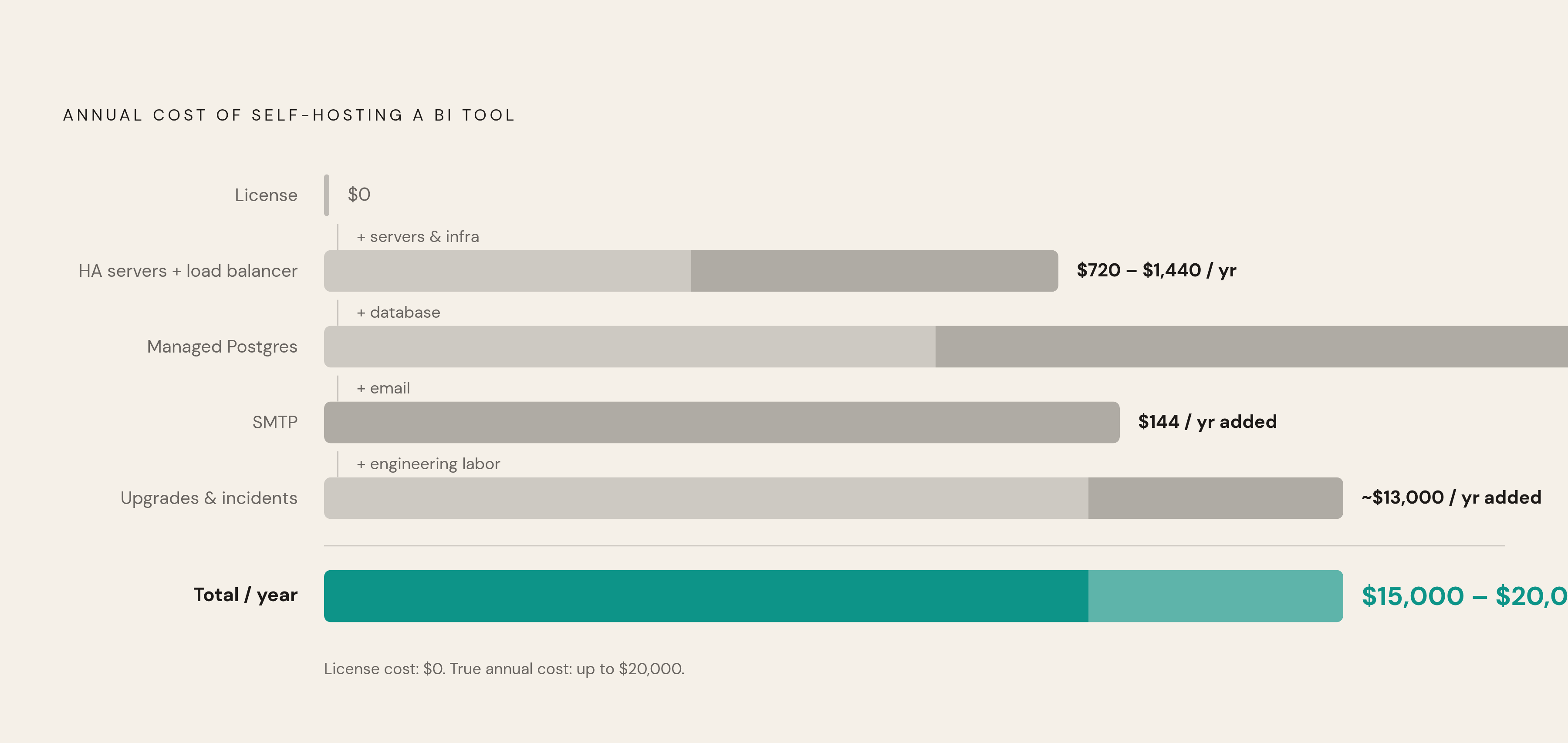
- High-availability servers: roughly $48 or more a month
- A load balancer: around $12 or more a month
- A managed database (Postgres is the usual recommendation): $40 to $60 or more a month
- An SMTP server for email and alerts: about $12 or more a month
Add that up and a bare-bones production setup on AWS or GCP lands somewhere between $100 and $200 a month, before anyone spends a single hour maintaining it. Factor in quarterly upgrades and the engineering time that goes into responding to incidents, and total yearly cost can climb to $15,000 to $20,000, according to a 2026 pricing analysis from coefficient.io. That's before a single analyst has opened a dashboard.
The default embedded databases that ship with a lot of these tools aren't built for production. They can corrupt from filesystem errors, and they can't be shared across multiple instances, which rules out load balancing or high availability. That's why a separate, managed database is the standard recommendation, not an optional upgrade.
Minimum hardware tends to sit around 2GB of RAM plus that external database. But hardware is the easy part. Here's what actually lands on a team's plate once it self-hosts:
- Managing containers (usually Docker)
- Watching for memory leaks during heavy queries
- Running backups by hand
- Running upgrades by hand
- Renewing SSL certificates
- Setting up multi-zone availability
- Building out monitoring so someone finds out about a problem before a customer does
Every one of those tasks gets handled automatically on a managed cloud plan. That's not a marketing line, it's the literal delta between the two paths.
There's a specific trap worth naming here too: a dashboard that got forgotten, still polling a data warehouse every minute, can quietly run up a large query bill. Query timeouts and caching minimums stop this from happening, but on a self-hosted setup, someone has to remember to configure those guardrails. On a managed plan, some of that protection is often built in by default.
How paid tiers change the math for self-hosters
Self-hosting looks most attractive at the free tier. But most teams don't stay on the free tier for long, because the features that make self-serve data access safe (row-level permissions, single sign-on, audit logs) tend to live behind a paywall.
A typical pricing ladder in this space runs something like this:
- Open source / free tier: self-hosted only, core BI features, all the standard connectors, basic embedding with a visible attribution badge. No SSO beyond a basic option, no row-level security, no column-level permissions, no audit logs, no white-labeling, and support is whatever you can find on a community forum.
- Entry-level paid tier: often around $100 a month for a handful of users, plus a per-seat charge for each additional one. Adds managed hosting and email support. Still no advanced SSO, still no row-level security.
- Mid-tier plan: often several hundred dollars a month, unlocking row-level security, interactive embedding, white-labeling, and usage analytics.
- Enterprise tier: custom pricing, often starting around $20,000 a year, adding air-gapped deployment options, a dedicated support contact, and faster response times. The feature set is usually identical to the mid-tier plan, just with better support and compliance options attached.
The jump between the entry tier and the mid-tier is where a lot of teams get surprised. If a team needs row-level security, interactive embedding, or real SSO, there's rarely a cheap in-between option. Budgets built around the entry price often don't survive contact with that jump.
Annual billing can knock around 10% off the base fee for some plans, which softens things a little.
Self-hosting the paid tiers is often possible too. Plenty of vendors don't charge extra for self-hosting versus managed hosting at the same tier. But choosing to self-host at that price point means paying the plan fee and carrying all the infrastructure overhead described above. That's the worst of both worlds if a team isn't careful: full price, plus the maintenance job.
AI-assisted querying add-ons have started showing up too, usually priced per block of requests on paid cloud plans, with availability on self-hosted deployments varying by vendor and tier.
The practical pattern: a team starts on the free tier to avoid cost, discovers a few months in that it actually needs SSO for security reasons or row-level permissions for multi-team access, and ends up re-evaluating the entire "free" decision anyway.
What managed admin panel builders handle instead, and at what cost
Admin panel builders solve a different problem: giving non-technical people the ability to act on data, not just look at it. Editing records, triggering workflows, managing user accounts.
The maintenance job shifts too. Instead of keeping BI infrastructure running, a team maintains the apps built on top of the platform: queries, component setups, permission rules.
A few names worth knowing in this space:
Retool leans developer-focused, with pre-built UI components wired up to databases and APIs. It offers multiple tiers, including options for small teams and enterprise pricing. At around 100 users, per-seat billing on the business tier adds up to a meaningful annual number fast. Retool's customer base includes companies like DoorDash and Mercedes-Benz.
Appsmith is open source at its core (community edition, Apache 2.0 license), with tens of thousands of GitHub stars and a genuinely free self-hosted option. Paid business tiers carry a per-user charge, and audit logs plus role-based access are among the features reserved for those tiers. Full SSO requires a higher paid tier. Self-hosting requires its own hardware budget, similar in shape to other self-hosted tools in this category. Worth noting: self-hosting Appsmith brings the exact same category of maintenance work as self-hosting a BI tool. It just moves the burden from BI infrastructure to app-builder infrastructure.
ToolJet is another open-source internal tool builder, with a large library of data source connectors. Billing is based on builders, not end users, which helps teams with a lot of viewers and few editors, though end-user caps can still force an upgrade. It tends to include broader AI features and data connectors than some competitors, though it has a smaller market share than the biggest player in the category.
Superblocks sits at the more managed end, with a polished platform, an open-source agent option, and a paid team plan at a premium price point per builder. There's no cheap self-hosted option here, it's the most hands-off, and the most expensive, of the group.
The pattern holds across all four: going managed cuts down on maintenance work, but per-user or per-builder pricing adds up fast as a team grows. Self-hosted options exist (Appsmith, ToolJet), but they bring back the same infrastructure question that self-hosted BI tools raise.
Worth saying plainly: none of these four replace dashboards or saved-query analytics on their own. A team that needs both ends up running two separate systems, which is its own kind of overhead.
Where a database-native BI tool fits when neither path quite works
Both paths above leave a gap.
Self-hosted BI gives full analytical power, but engineering owns the ongoing infrastructure work indefinitely. Managed admin panels give teams the ability to act on data, but dashboards and analytics are usually an afterthought, if they exist at all.
A third option sits in between: tools that connect directly to a production database (Postgres, MySQL, and others) and surface dashboards, saved queries, editable data views, and permissioned access, all without a separate BI stack or a custom internal app.
In practice, that tends to look like this:
- Engineering or a data team sets it up once and manages permissions from there
- Product, sales, marketing, support, and ops teams answer their own data questions without filing a ticket or writing SQL
- Row-level permissions let non-technical people safely edit records without ever touching raw database credentials
The appeal here is less about features and more about what doesn't have to happen: no second BI stack to maintain, no per-viewer pricing that scales up every time headcount grows. The database is already running. The tool just gives people a safe window into it.
It's also worth considering why self-serve analytics efforts fail in the first place. A tool that enforces permissions and definitions at the database level, rather than downstream in a separate app, addresses that at the root instead of patching it later.
This tends to matter most for a company sitting around 100 employees. Large enough that product, sales, ops, and support all genuinely need their own access to data. Small enough that standing up and maintaining a full, separate BI stack is a real tax on a team that has other things to build.
The four scenarios that actually determine which path makes sense
Scenario 1: Regulatory or compliance requirements. Think HIPAA, data residency rules, or a genuine need for an air-gapped environment. Here, self-hosting often isn't a choice, it's the only option, because the data legally cannot leave your own infrastructure. The engineering overhead is simply the cost of doing business under those rules. At this level, a self-hosted enterprise BI plan or a self-hosted open-source admin panel are the realistic paths.
Scenario 2: A small team with simple reporting needs and real DevOps capacity. A free, self-hosted BI tool is a reasonable place to start. Infrastructure costs stay manageable, and missing features aren't a dealbreaker yet. The risk: governance needs like SSO and row-level security tend to show up sooner than expected, forcing a tier jump before the team planned for one.
Scenario 3: A cross-functional team that needs self-serve analytics without a governance headache. A managed mid-tier BI plan, or a database-native BI tool, removes the infrastructure job and includes the permission controls that make broad self-serve access safe. Per-user pricing deserves real scrutiny here. A large group of occasional viewers on a per-seat plan gets expensive fast, so tools that price by builder, or by flat infrastructure cost, are worth comparing on total spend, not sticker price.
Scenario 4: A team that mostly needs to act on data, not analyze it. A tool for editing records, managing user accounts, running operational workflows. This is admin panel territory, not BI territory. The self-hosted-versus-managed question applies here too: some tools in this category offer real self-hosted options, others are managed only, with per-user costs that climb at scale.
The throughline across all four: the right choice depends less on which tool has the longer feature list and more on where a team can actually absorb the ongoing work. Infrastructure, upgrades, permissions, incident response. All of it has to live somewhere, on somebody's plate, on some kind of schedule.
One last practical note. Starting on a managed cloud plan and moving to self-hosting later is a path some tools support. Going the other direction, from self-hosted back to managed, tends to be harder. Configurations get locked in, exports get messy, and what looked like a reversible decision on day one often isn't.