Database Credential Rotation Without Application Downtime
A dual-credential approach lets you rotate database passwords without interrupting service.
Database credential rotation goes wrong at the exact moment someone thinks it's finished. The common pattern, reset the password, update the environment variable, redeploy, feels complete the second the deploy succeeds. It isn't. Every other system still holding the old password starts failing right then, and that failure is what this piece is about: why the obvious way to rotate a credential causes the outage it's supposed to prevent, and what to do instead so rotation never costs you uptime.
Why credential rotation causes outages instead of preventing them
Picture the standard move. Someone opens the database dashboard, resets the password, copies the new value into an environment variable, and redeploys the one service they're thinking about. That sequence works fine, for that one service. A database password usually isn't used by one service: it's used by a second server, a cron job, a background worker, a serverless function that's about to cold-start, maybe a read replica quietly running reports. None of those get the memo.
The moment the old password stops working, every one of those other consumers fails. Not gracefully, and not with a helpful retry. Authentication errors start immediately, right when the person doing the rotation believes the job is done. PandaStack's August 2026 analysis finds the mechanism is specific to how Postgres handles authentication: it checks the password at connect time, not continuously, so connections that are already open keep working. But connection pools are constantly cycling, opening new connections to replace old ones, and every new connection attempt with the old password fails on the spot. That turns what looks like a clean, instant change into a partial outage with no fixed end point, because nobody can predict exactly when every pool, worker, and cold-start function will next try to reconnect.
Rotation gets pushed to some future maintenance window, and that window has a habit of never arriving. Credentials sit untouched for months, sometimes years, because the one time someone tried to rotate one, half the stack broke.
The scale of the problem makes "just be more careful next time" a weak answer. OnlineShieldHub's analysis finds that machine identities, service accounts, API keys, database tokens, now outnumber human employees by close to fifty to one in a typical cloud environment. Each one of those is a credential somebody has to rotate correctly, and CheckYourVibe's 2026 guide points out which ones get missed most often: scheduled jobs, migration scripts buried in a CI pipeline, admin scripts someone runs by hand from a laptop, and read-replica tools quietly pulling reports in the background. Those are the consumers still using the old credential long after everyone else assumes the rotation finished.
What compliance frameworks and breach data say about rotation
None of that makes a strong case for skipping rotation. The pressure to rotate keeps building even though the naive way of doing it keeps causing outages, so the naive way needs to be replaced rather than abandoned.
Start with the rules. PCI DSS v4.0, under Requirement 8, calls for unique credentials per user and per service account. Shared credentials are only allowed with a documented, management-approved exception, under Requirement 8.2.2, and application and system account credentials need to rotate at least once a year under Requirement 8.6.3. A shared database password that barely ever changes is a compliance gap under that standard, and CheckYourVibe's guide treats it as one of the first things an auditor will flag.
This complicates the "just rotate more" instinct, because NIST's SP 800-63B guidance actually argues against forcing password changes on a fixed schedule for human users. Mandatory 90-day resets with no actual risk signal behind them tend to produce weak, predictable patterns, like a password that just increments by one each cycle, and they push people toward hardcoding credentials somewhere just to avoid the hassle. Some of that logic carries over to machine credentials too: rotating a database password on a rigid calendar, with no regard for how the rotation gets executed, creates the same incentive to cut corners.
The real lesson from putting those two things side by side concerns how rotation gets done, not how often to rotate. Frequent rotation only becomes safe to adopt as a habit once the method itself stops causing outages. A rotation process that survives contact with a busy engineering team, one that nobody has to brace for, is the only kind that actually gets run on schedule instead of indefinitely postponed. That's the gap the next section closes.
The dual-credential pattern that eliminates the outage window
The fix is simpler than the failure mode makes it sound: keep two valid credentials active at the same time. Every consumer of the database gets to move over to the new one at its own pace, and the old one only gets shut off once nothing is using it anymore. At no point in that process does the old credential stop working before the new one is confirmed live everywhere that needs it.
PandaStack's guide identifies continuity as the property that makes this work: at every single instant during the rotation, at least one valid credential is in the secret store. There's no gap where the old password is dead and the new one hasn't landed yet. No partial outage, no maintenance window to carve out of someone's calendar, because nothing ever actually goes down.
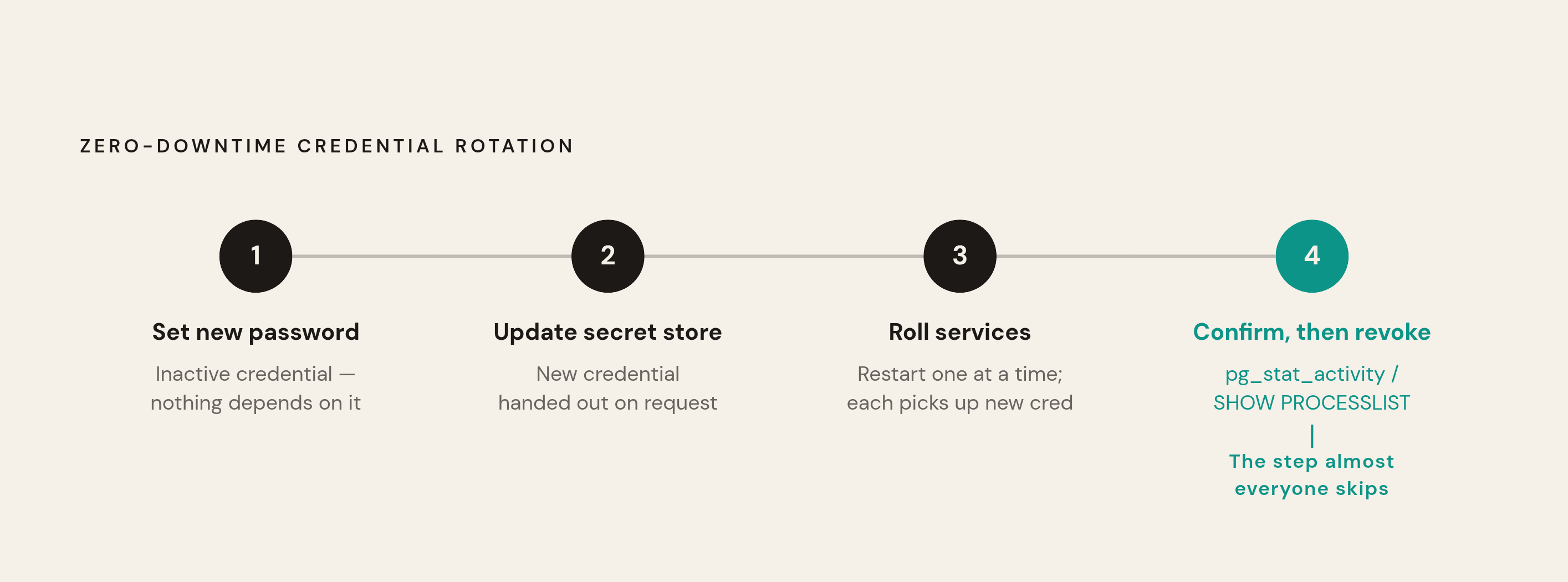
In practice, the sequence runs in four steps. First, set a new password on a credential that isn't actively in use yet, so nothing currently depends on it and nothing breaks when it changes. Second, update the secret store so it starts handing out the new credential to anything that asks. Third, roll services over one at a time rather than all at once, letting each one pick up the new credential the next time it restarts, so a mistake in one service's connection string only takes that one service down instead of the whole stack. Fourth, and this is the step almost everyone skips, confirm that nothing is still connected using the old credential before revoking it. That confirmation is the one most teams rush past, and it's where things quietly go wrong even when the first three steps were done right. Checking pg_stat_activity in Postgres, or SHOW PROCESSLIST in MySQL, before pulling the trigger on revocation is the only way to know for sure, because a background worker sitting on a long deploy cycle, or a cron job that only runs once a week, can still be connected under the old user hours after everyone assumes the migration is complete.
The exact mechanics shift a bit depending on the database, but the underlying shape holds everywhere. In Postgres, a single role only ever has one password, so real zero-downtime rotation means creating a second role with the same grants, something like app_a and app_b, both belonging to a shared role that actually owns the permissions, moving consumers over to the new role, and dropping the original once it's clear. PandaStack's August 2026 guide walks through this two-user setup directly. MySQL 8 and later makes this easier at the engine level: ALTER USER supports RETAIN CURRENT PASSWORD to keep the old one valid alongside the new one, and DISCARD OLD PASSWORD once the migration is confirmed, with no second user needed, per CheckYourVibe's guide. MongoDB Atlas handles it by letting an operator create a second database user through the UI or API with identical roles, since Atlas already supports multiple simultaneous users on one cluster without any extra setup. Redis and Upstash follow the same logic through ACLs: add a second ACL user or token instead of touching the primary password, assuming the plan supports Redis ACLs, which arrived in Redis 6. On managed Redis without ACL support, a short overlap window might be unavoidable, so checking the provider's own rotation documentation first is worth the five minutes it takes.
As database access spreads across more consumers, reporting tools, internal dashboards, scheduled analytics jobs, each one holding its own copy of a credential, the job of tracking who's using what during a rotation gets harder fast. Basedash and similar platforms that centralize self-serve SQL access sidestep part of that problem by having the platform itself hold the database connection, rather than handing out a separate credential to every person and script that needs access.
The connection pooler step that almost every rotation guide skips
A failure mode shows up after everything above has already been done correctly: the dual-credential rotation runs clean, the team confirms no connections remain on the old user, the old credential gets revoked, and then production starts throwing intermittent authentication errors anyway. The cause almost always traces back to a connection pooler.
Updating an application's database URL doesn't close out connections that a pooler already has cached. Tools like PgBouncer, Supabase's built-in pooler, and RDS Proxy keep a pool of connections that are already authenticated and reuse them across incoming requests instead of opening a fresh connection every time. The pooler has to be told, separately from the application, to refresh those connections. If it isn't, some share of requests keep flowing through connections that were authenticated under the credential that just got revoked.
That's why rotation can look flawless in staging and then fail unpredictably in production under real load. Staging usually has light enough traffic that the pooler cycles through its connections naturally within the test window. Production, under heavier load, keeps old pooled connections alive longer, and a chunk of requests hit those stale connections.
The fix is to treat the pooler as its own consumer that needs an explicit refresh, not something that updates itself just because the application did. On Supabase specifically, the pooler configuration does pick up role changes on its own, usually within a few minutes, but restarting the pooler add-on from the dashboard forces the change through immediately instead of waiting. Any rotation checklist that doesn't include a pooler refresh step has a gap in it, full stop on the planning, not on the execution.
Wiring Kubernetes rotation to a rollout strategy
Kubernetes adds its own version of this same trap. Updating a Kubernetes Secret object changes what value is stored, but it doesn't make running pods start using that new value right away. The rotation only actually finishes once there's a rollout strategy attached to it that confirms workloads have picked up the change, not just that the secret object itself was updated.
Tools like External Secrets Operator handle part of this by continuously syncing values from an external secret manager into Kubernetes Secret objects, on a configurable refresh interval. But syncing the secret object is only half the job. An application reading its credentials as environment variables needs a pod restart before it'll see the new value at all, since environment variables get read once at startup, not watched for changes. Applications that read credentials from a mounted file might pick up the change automatically, or might not, depending on how the application itself is written.
One worked example shows how to close that gap. A workflow described in Ismail Wajdi's March 2026 guide, built with n8n, pairs the secret update with a rolling restart of the deployment, so running pods pick up the new credential without taking the whole service offline at once. The sequence runs as a schedule trigger, then a step that fetches the active database users, a loop through each one, generating a new password, running an ALTER USER command against Postgres, base64-encoding the new credentials, patching the Kubernetes secret, triggering a rolling restart of the deployment, and sending an email notification if any step along the way fails.
The specific tool matters less than the principle it demonstrates. Rotation needs to be tied to something that confirms the new credential is actually in use rather than merely stored somewhere. PandaStack's August 2026 guide makes the comparison to synchronous operations elsewhere in a platform: verifying a change took effect before telling the system the job is done matters just as much here as anywhere else, and skipping that verification is how a rotation that looks successful on paper turns into a slow leak of failed requests over the following hours.
Implementing the two-credential strategy in managed platforms and secret managers
Some of the clearest examples of this pattern come from teams that have already built it into their infrastructure rather than running it by hand each time.
Polar published a public engineering runbook, dated September 25, 2026, that documents exactly this process for rotating its Postgres default user and password, using Render's built-in credential rotation feature. Render generates a new password, and optionally a new username, for the new credential pair and promotes it to be the new default, while leaving the original user fully intact and working until it's explicitly deleted in a later step. Terraform then reads the new credentials and pushes them out to every service through a shared environment group, and services get redeployed manually, one at a time, rather than all at once. Only after pg_stat_activity confirms there are zero active connections under the old user does the runbook call for deleting it.
Read replicas in Polar's setup pick up the same rotated credentials as the primary database automatically, since they pull from the same Terraform variables, but the runbook is explicit that services, including those read replicas, sometimes need a manual redeploy before they actually use the new values. The runbook also notes there's no rollback built into this process. If something goes wrong, the fix is to roll forward with a fresh set of credentials rather than reverting, so the confirmation step before deleting the old user matters as much as it does. And the runbook flags one organizational gap directly: any BI tool connected to the database with its own separate copy of credentials sits outside the infrastructure-as-code path entirely and has to be updated by hand. That's the exact failure point that centralized access tools are built to close. A platform that manages database connections in one place, logging active sessions so the confirmation step (checking pg_stat_activity or SHOW PROCESSLIST before anything gets revoked) is a quick lookup instead of a hunt through a dozen disconnected tools and scripts, removes the guesswork that usually causes rotations to go sideways.
HashiCorp Vault takes a different approach to the same underlying problem by removing the long-lived credential. With Vault's dynamic secrets, a service requests a credential when it needs one, and Vault generates a short-lived credential on the spot, with a TTL that automatically expires and revokes it. There's no rotation event to schedule in the first place, because there's no long-lived password sitting around to rotate. Services request credentials from Vault directly instead of reading a static value out of an environment variable.
Where dynamic secrets aren't practical, Vault's static roles offer a middle ground: operators can rotate a password without creating and deleting a database user each time. That matters more at scale than it might sound, since creating and deleting database users repeatedly can cause table locks that affect database performance, a cost that's easy to overlook until it's happening in production under load.
Sources
- How to Rotate Database Credentials Without Downtime (2026)
- Rotate Database Credentials With Zero Downtime · PandaStack
- Top AI Password Rotation Tools for Cloud Vaults (2026)
- Rotate Database Credentials - Polar Handbook
- Automate Database Credential Rotation with n8n and Kubernetes: A Zero-Touch Security Workflow
- How to Use Secret Rotation with External Secrets Operator Refresh Intervals
- HashiCorp Vault